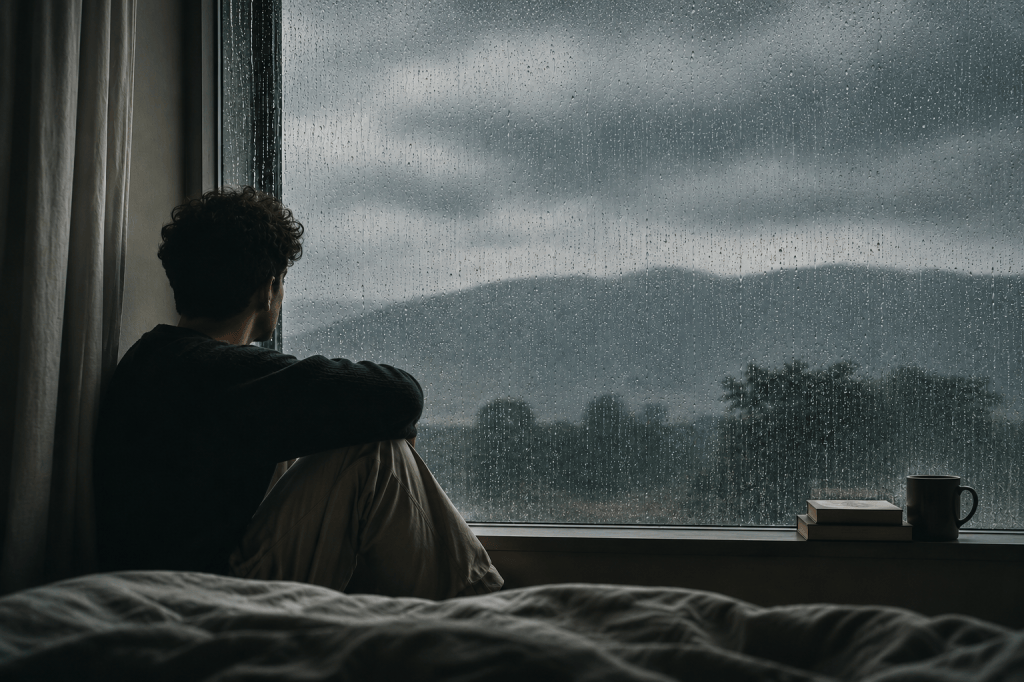
On grief, the passage of time, and the strange permanence of those who are no longer here.
There is something profoundly unsettling about the way the world continues after someone dies.
The sun rises, streets remain crowded, people go about their routines, conversations continue, and life carries on with an almost uncomfortable sense of normality. Somewhere, someone is laughing. Somewhere, someone is making plans for tomorrow. The world does not pause, nor does it acknowledge that an entire universe may have collapsed within someone else’s life.
Perhaps that is one of the strangest contradictions of human existence: an event capable of changing someone’s entire universe barely interrupts the universe itself.
We often imagine grief as something visible — tears, sorrow, sleepless nights, or the inability to speak about the person we have lost. But grief is not always loud. Sometimes, it exists in the spaces between ordinary moments. It appears in conversations where a familiar voice is missing, in memories that arrive without invitation, and in the quiet realisation that someone who once occupied a physical space in our lives is no longer there.
And perhaps the most difficult part is not accepting that someone has died, but understanding how everything else can continue as though nothing extraordinary has happened.
The World Doesn’t Stop
Time has a peculiar relationship with human suffering.
When something devastating happens, we often wish time would slow down. We want the world to wait, if only for a moment, so that our minds can catch up with what has happened. But time offers no such courtesy.
Days turn into weeks, weeks into months, and eventually, the world expects us to return to its ordinary rhythm.
There are responsibilities to fulfil, conversations to participate in, work to complete, and decisions to make. Slowly, the external world begins to look familiar again. Yet something internally remains altered.
This creates a strange contradiction: a person can return to their everyday life without ever returning to the person they were before.
Perhaps this is why grief is so difficult to explain. It does not necessarily prevent us from living; it changes the experience of living itself.
The Architecture of Absence

We tend to think of absence as the opposite of presence. If someone is no longer physically here, we assume their presence has ended.
But human relationships are rarely so simple.
A person becomes part of our habits, our language, our memories, and even the way we understand ourselves. Their influence gradually finds its way into ordinary things. A familiar expression, a shared joke, a particular place, or an insignificant moment can suddenly bring their memory into the present.
It is almost as though the mind has constructed an invisible architecture around the people we love. Even when they are gone, the structure remains.
Philosophically, this raises an interesting question: does someone’s existence end entirely when their physical life ends, or does some part of them continue through the people whose lives they have shaped?
Perhaps absence is not always an empty space. Sometimes, it is evidence of how deeply someone once belonged.
The Cruelty of Time
We often describe time as a healer, but perhaps that description is incomplete.
Time does not necessarily remove the weight of loss. It changes our relationship with it.
The initial shock may become less overwhelming, memories may become easier to revisit, and ordinary life may gradually find its rhythm. But this does not mean that the significance of the person has diminished.
There is a difference between becoming accustomed to an absence and no longer feeling it.
The passage of time also confronts us with another uncomfortable reality: our own mortality. The people we love are not permanent fixtures of existence, despite how permanent they may feel in our everyday lives.
We make plans as though tomorrow is guaranteed. We postpone conversations, delay expressions of affection, and sometimes assume there will always be another opportunity.
Yet life has never promised us that.
Perhaps the awareness of mortality is not meant to make us afraid of living, but more conscious of what living actually means.
The Persistence of Memory
Memory is a peculiar thing. It preserves what time cannot return.
We cannot recreate a conversation exactly as it happened, revisit a moment in its original form, or bring back the physical presence of someone who has died. Yet the mind continues to hold fragments of those experiences.
This brings us to a deeper philosophical question: what makes a person who they are?
Is it simply their physical existence, or is it also the collection of experiences, relationships, ideas, and emotions they leave behind?
The ancient Stoics reflected extensively on impermanence, while philosophers such as Martin Heidegger explored how our awareness of mortality shapes the meaning of existence.
But perhaps memory offers another way to understand human continuity.
A person’s life does not become meaningless simply because it has ended. Their influence may continue in the decisions others make, the values they carry, the stories they tell, and the countless ways they have changed the people around them.
We cannot preserve someone’s presence forever. But we do not necessarily lose everything that their presence created.
And perhaps that is the closest we come to understanding permanence in an impermanent world.

Learning to Live With Silence
Maybe healing is not about reaching a point where we no longer think about the people we have lost.
Maybe it is about learning that life can continue alongside their absence.
There is no universal timeline for grief, no definitive moment when everything suddenly makes sense, and no requirement to transform every painful experience into a lesson.
Some questions may remain unanswered. Some memories may always carry a certain weight. And some absences may never feel entirely ordinary.
But perhaps that is not a failure of healing.
Perhaps it is simply the human condition — the ability to carry love and loss at the same time.
We spend much of our lives searching for permanence in a world defined by change. We want people, moments, relationships, and experiences to remain exactly as they are. Yet existence offers no such guarantee.
What it offers instead is something more fragile: the opportunity to experience, to connect, to love, and to become part of one another’s stories.
And when those stories change, we are left with memories that time can soften but cannot recreate.
Perhaps the silence after loss is not entirely empty.
Perhaps it is filled with everything that once was.
And maybe the greatest tragedy of losing someone is not that we eventually forget how their presence felt, but that we continue discovering new moments in life that we wish we could have shared with them.


Leave a Reply