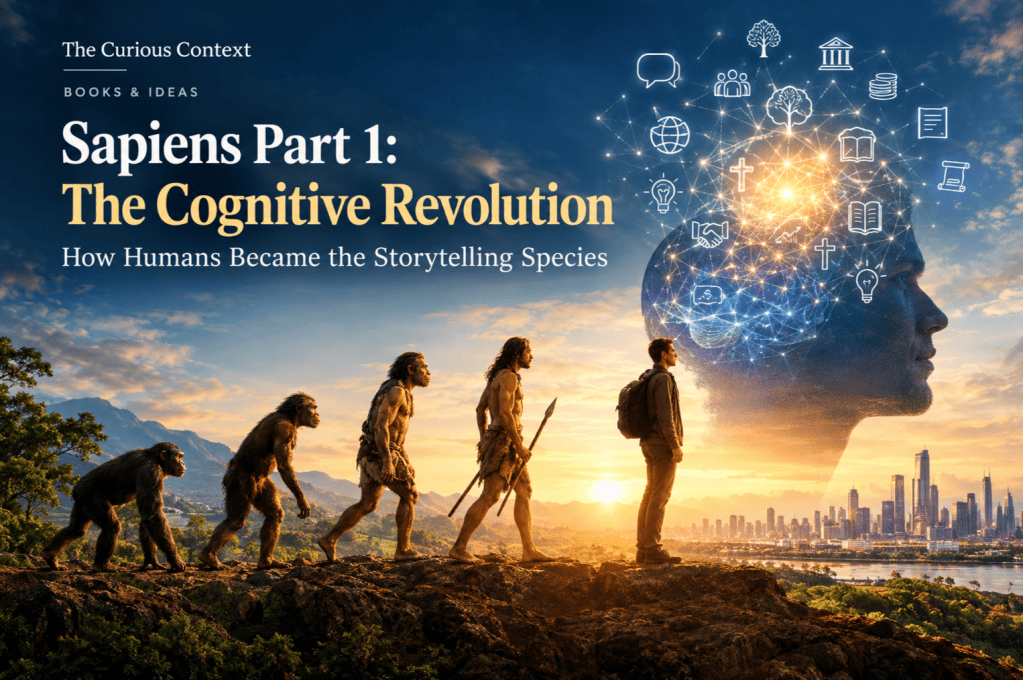
What made Homo sapiens different from every other human species?
Around 70,000 years ago, something remarkable happened.
Homo sapiens began doing things that seem strangely familiar to us today—but would have been extraordinary for a prehistoric human.
They created complex tools. They crossed seas. They travelled into unfamiliar environments. They formed larger social networks. They created art, rituals and symbols. Most importantly, they became capable of cooperating in increasingly flexible ways.
Yet there was nothing particularly impressive about Homo sapiens physically.
We were not the strongest animal.
We were not the fastest.
We did not have the sharpest claws or the largest teeth.
For most of our existence, humans were simply another animal trying to survive.
So how did this relatively ordinary ape eventually build cities, empires, religions, corporations and entire civilizations?
In Sapiens: A Brief History of Humankind, historian Yuval Noah Harari argues that one of the biggest turning points was the Cognitive Revolution—a transformation in how Homo sapiens thought, communicated and organized themselves.
Harari places this revolution roughly 70,000 years ago, although the precise timing and causes of major changes in human behavior remain subjects of scientific debate.
The deeper lesson of Part One is not simply that humans became “smarter.”
It is more interesting than that.
Humans became exceptionally good at creating and sharing information, imagining possibilities, and cooperating around common ideas.
And that may have changed the history of our species forever.
1. Before We Became “Sapiens”
Today, it is easy to imagine that humans were always the dominant species.
They weren’t.
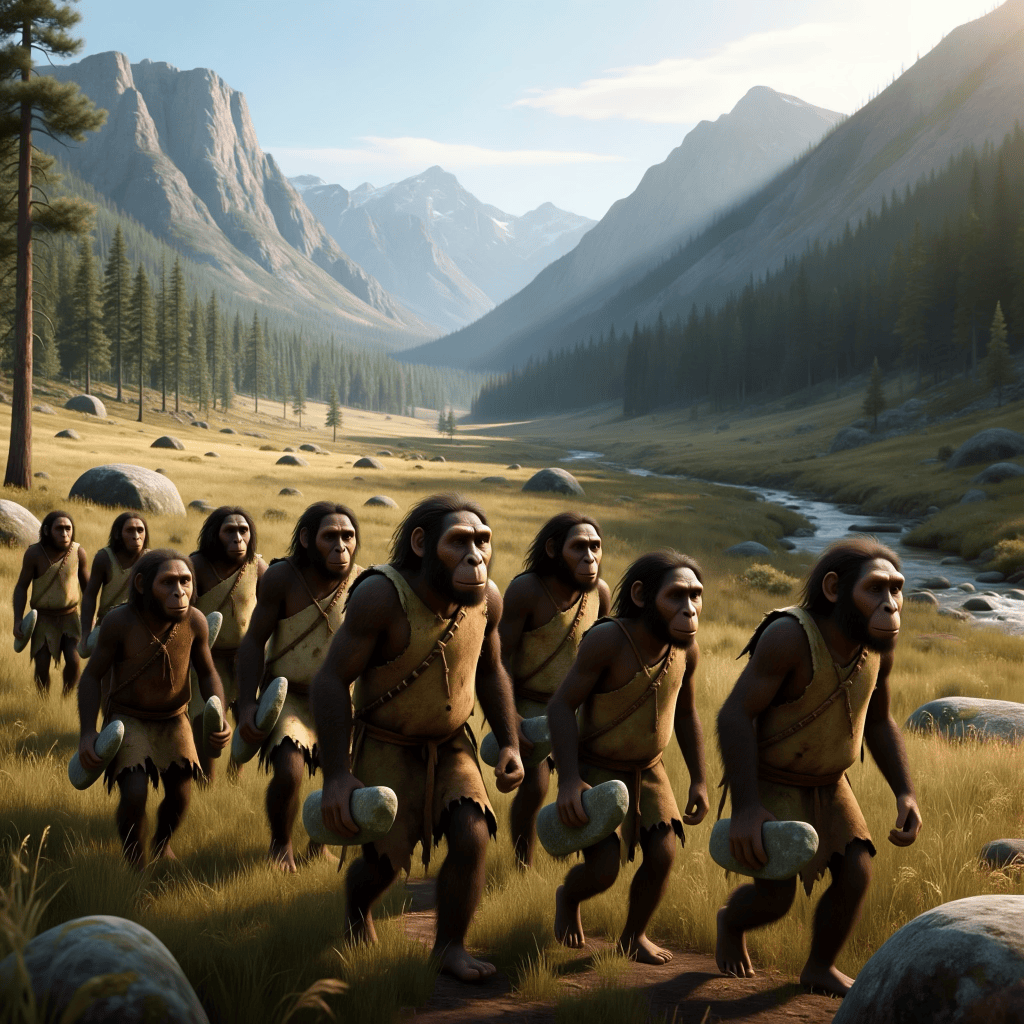
Homo sapiens was only one member of a much larger human family.
For hundreds of thousands of years, different human species lived on Earth. Neanderthals lived across parts of Europe and western Asia. Homo erectus survived in Asia for an extraordinarily long period. Other human populations, including Denisovans and Homo floresiensis, also existed.
Homo sapiens was therefore not the inevitable winner of some evolutionary competition.
We were one branch of a much larger evolutionary tree.
This changes the way we should think about human history.
Human history did not begin with modern humans ruling the planet.
It began with humans struggling to survive alongside other humans.
The surprising part
For a very long time, humans occupied a relatively ordinary position in nature.
Early members of the genus Homo appeared around 2.5 million years ago, but for much of that enormous period, humans did not transform the planet on the scale that modern societies do.
We had large brains.
We could walk upright.
We could make tools.
We could control fire.
But these advantages did not immediately turn us into masters of the planet.
That raises an important question:
If humans had possessed large brains and tools for hundreds of thousands of years, why did the world change so dramatically later?
Harari’s answer begins with the Cognitive Revolution.
2. What Was the Cognitive Revolution?
The Cognitive Revolution refers to a major transformation in human thinking and communication that Harari places around 70,000 years ago.
It wasn’t a single day when humans suddenly became intelligent.
There was no prehistoric morning when one person woke up and thought:
“I have an excellent idea. Let’s invent civilization.”
Evolution doesn’t work like that.
Instead, Harari uses the term to describe a period when Homo sapiens developed new abilities to communicate, think, imagine and organize information.
The most important change was not simply the ability to communicate.
Other animals communicate.
Bees communicate the location of food.
Monkeys communicate warnings.
Many animals use sounds, gestures and signals to coordinate behavior.
The important question is:
What could humans communicate that other animals couldn’t communicate in the same way?
According to Harari, one answer was extraordinary:
Humans could talk about things that did not physically exist.
3. The Real Superpower: Talking About Things That Don’t Exist
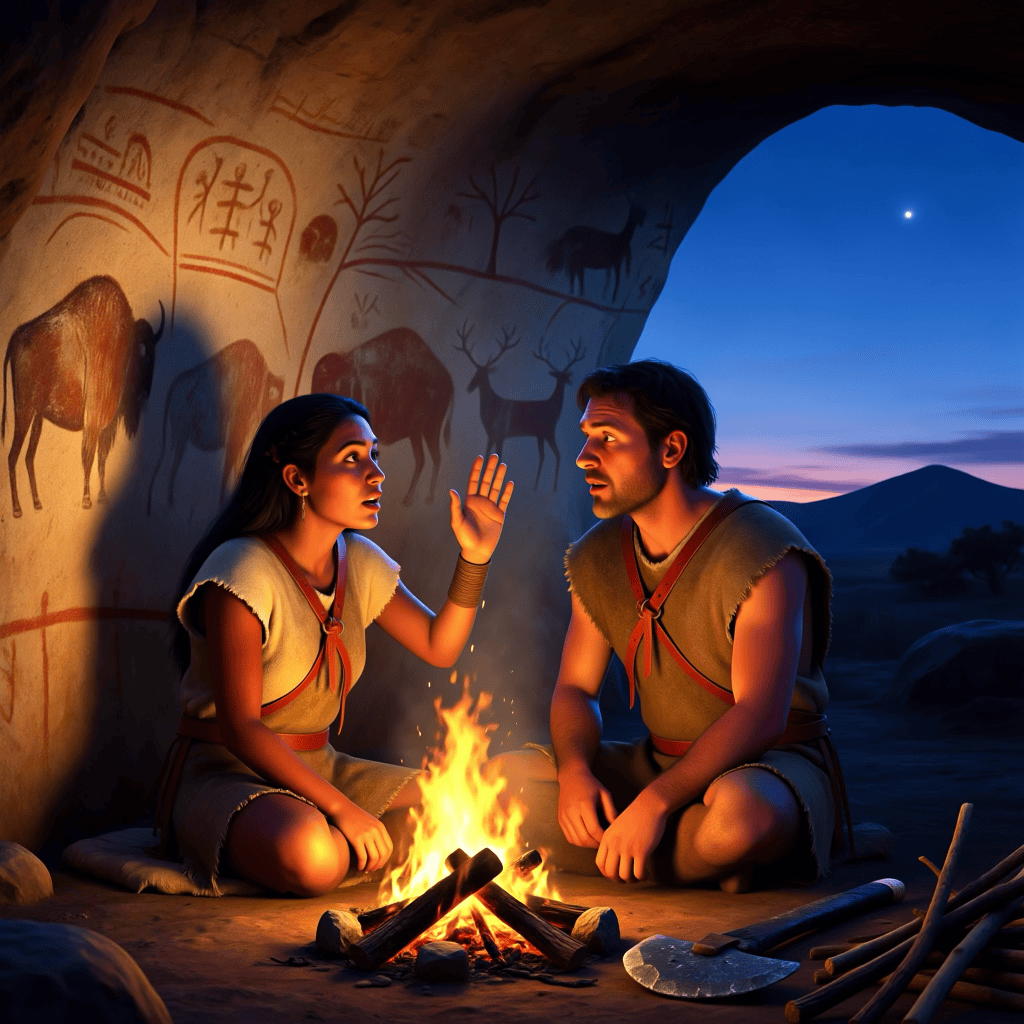
Imagine an early human saying:
“There is a lion near the river.”
That’s useful information.
It could save someone’s life.
But imagine another person saying:
“The spirit of our ancestors wants us to hunt tomorrow.”
There may be no physical object corresponding to this “spirit.”
Yet a group can still organize itself around the idea.
This is where human language becomes much more powerful.
Humans could discuss:
- things that happened in the past
- things that might happen in the future
- distant places
- invisible forces
- imaginary creatures
- social rules
- myths
- ancestors
- gods
- group identities
This gave humans something extremely unusual:
the ability to create a shared mental world.
Harari calls these shared ideas imagined realities.
The word “imagined” can be misleading.
It does not necessarily mean that people are deliberately pretending.
A person can sincerely believe in a god, a nation, money, a legal system or human rights.
These concepts may not exist in the physical world like a tree or a mountain, but they can still have enormous consequences because millions of people collectively recognize them.
4. From Gossip to Cooperation
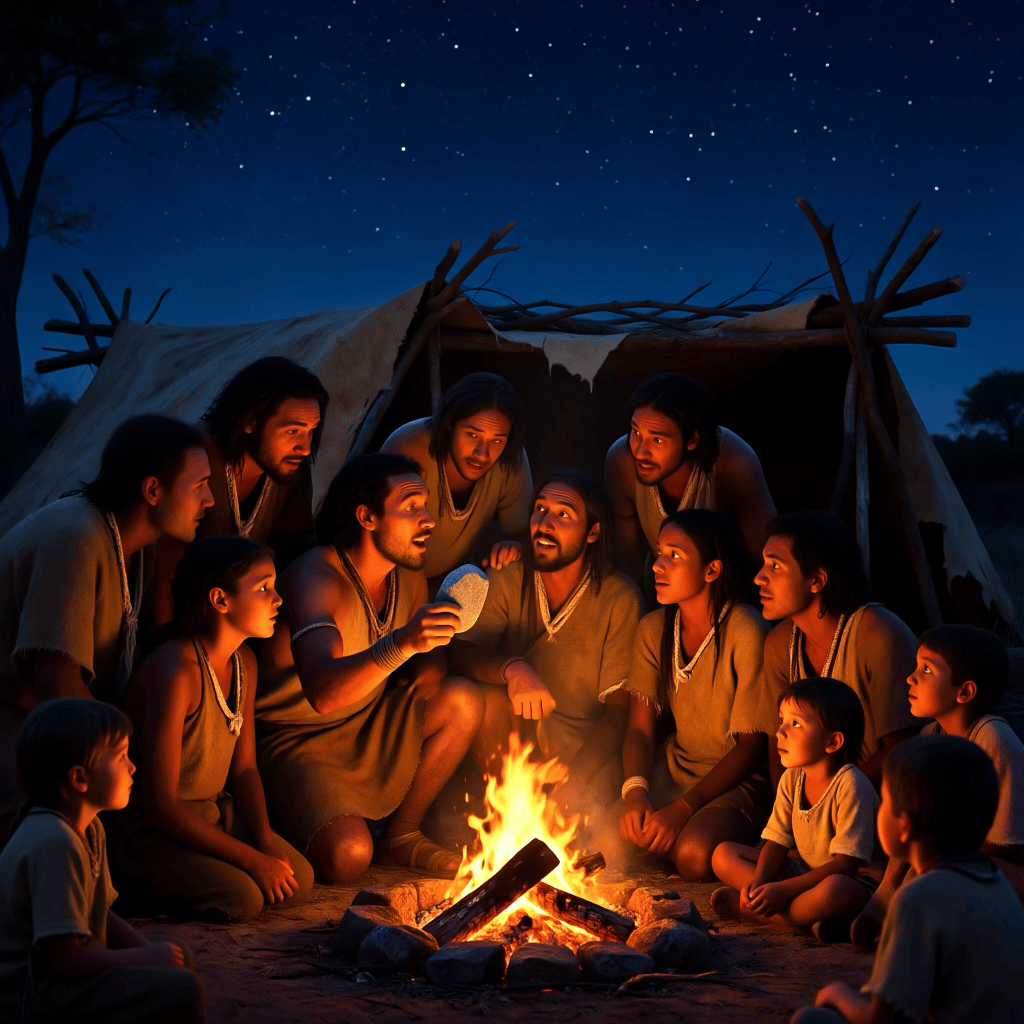
There is another fascinating possibility Harari discusses: perhaps language developed partly because humans needed to keep track of one another.
Think about a small prehistoric community.
Who is trustworthy?
Who stole food?
Who is angry with whom?
Who is a good hunter?
Who is looking for a partner?
Who can be relied upon during a dangerous situation?
Social information is extremely valuable.
In a small group, knowing what other people are doing can directly affect your survival.
This is sometimes called the gossip theory of language.
The basic idea is simple:
Information about other people can be as important as information about the physical environment.
Knowing where the water is matters.
But knowing whom you can trust when dividing food matters too.
Language therefore became more than a warning system.
It became a tool for managing relationships.
And once language could carry information about hundreds of people, cooperation could become much more flexible.
5. The Biggest Breakthrough: Shared Stories
Now we reach one of the central ideas in Sapiens.
A chimpanzee can cooperate with another chimpanzee.
A wolf pack can cooperate.
Ants can cooperate in enormous numbers.
So humans are not the only cooperative species.
The difference is the flexibility and scale of human cooperation.
Humans can cooperate with people they have never met.
Why?
Because strangers can believe in the same story.
Imagine that you and I have never met.
There is no reason for us to automatically trust each other.
But suppose we both believe that a particular piece of paper represents money.
Suddenly, we can trade.
Or suppose we both recognize the same country’s laws.
We can participate in the same legal system.
Or suppose we both believe that a particular company exists as a legal organization.
Thousands of employees and customers who have never met can coordinate their actions around it.
The physical objects are real.
But the institutional meaning attached to them exists because people collectively recognize it.
This is one of the most powerful ideas in Sapiens:
Human societies can become enormous because strangers can cooperate around shared ideas.
Harari argues that this ability eventually allowed humans to build organizations far larger than small bands of people connected only through personal relationships.
6. Our Two Realities
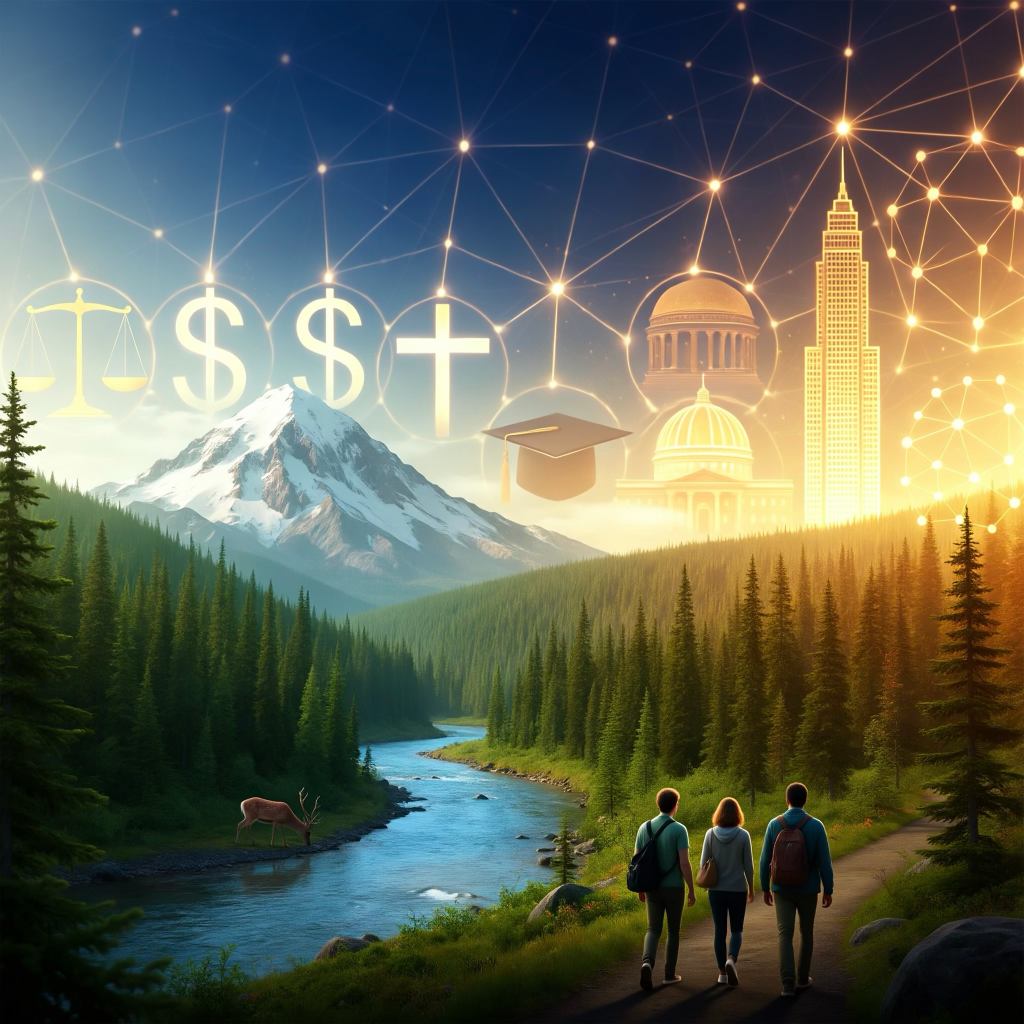
Harari describes humans as living in something like a dual reality.
There is the physical world:
- trees
- rivers
- mountains
- animals
- human bodies
- weather
And then there is the world created through collective human imagination:
- nations
- religions
- laws
- money
- corporations
- political systems
- social status
These two worlds interact constantly.
Take money.
A ₹500 note is physically just paper and ink.
Its purchasing power does not come from the paper itself.
It comes from a collective system of trust and agreement.
If everyone suddenly stopped accepting it as money, the physical note would remain—but its economic function would collapse.
The same principle applies to many institutions.
A corporation can own buildings.
A government can control territory.
A university can occupy a campus.
But the institution itself is not the same thing as its physical objects.
It exists through a network of shared rules, beliefs, legal recognition and collective behavior.
This is why ideas can become powerful enough to shape physical reality.
7. Why Stories Are More Powerful Than Facts
Consider two statements:
Statement A:
“There is a river 5 kilometres from here.”
Statement B:
“Our ancestors say that this river is sacred, and everyone in our community must protect it.”
The first statement describes something physical.
The second creates a social rule.
The river existed before the story.
But the story can change what humans do around the river.
This is an important distinction.
Stories don’t need to physically create an object to influence reality.
They can change human behavior.
And when enough people believe the same story, their collective behavior can create enormous institutions.
That is why stories became one of humanity’s most powerful technologies.
Not technology in the modern sense of computers or machines.
Rather, social technology.
A method of organizing human beings.
8. The Agricultural Revolution Wasn’t Inevitable
Before agriculture, most humans lived as hunter-gatherers.
They hunted animals, gathered plants, collected fruits, roots and other foods, and moved according to environmental conditions.
This lifestyle existed for an enormous portion of human history.
That matters because our minds and bodies were shaped during this long period.
Modern humans spend most of their lives inside buildings, staring at screens, sitting in chairs and eating food produced by enormous industrial systems.
But evolution did not design us specifically for this environment.
Our ancestors lived very differently.
Harari uses this contrast to ask an uncomfortable question:
What was everyday life actually like before farming and civilization?
And the answer is more complicated than “primitive people lived miserable lives.”
9. A Day in the Life of a Hunter-Gatherer
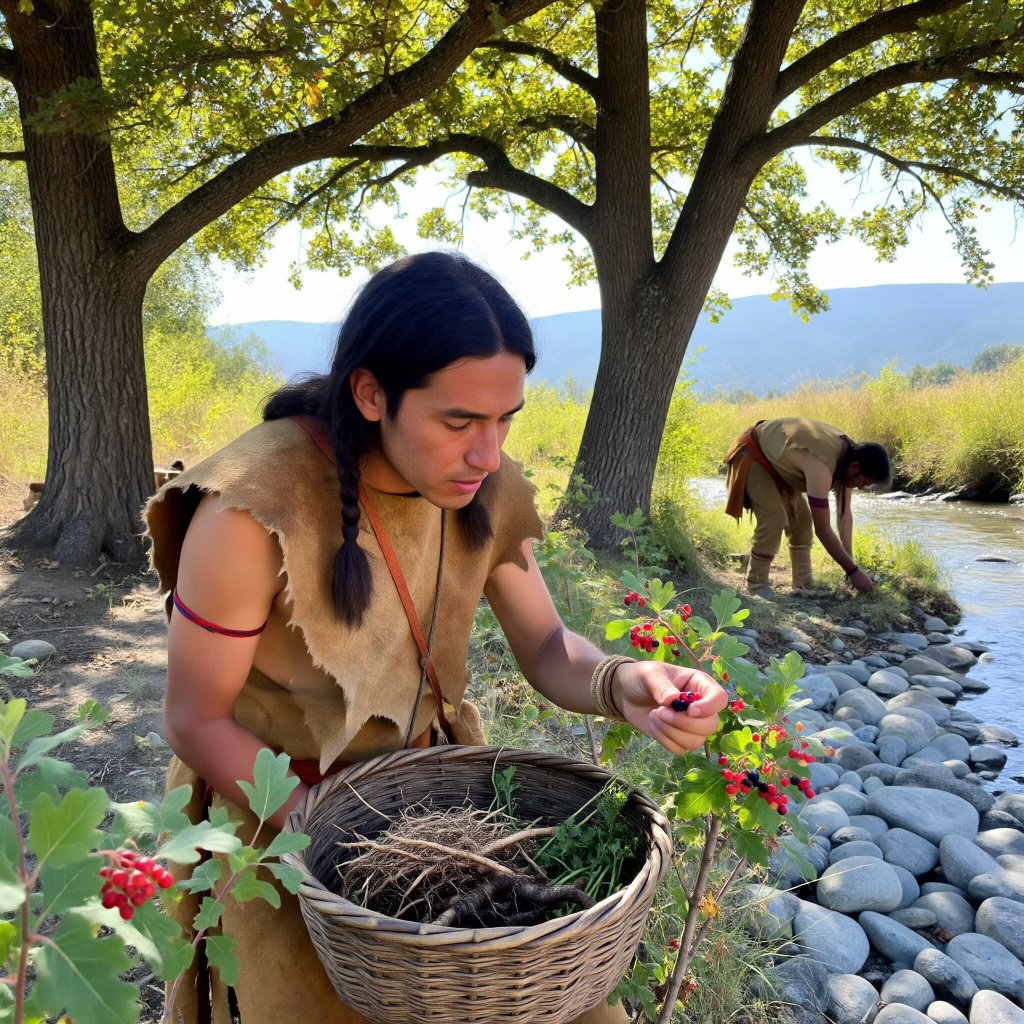
We have to be careful here.
We cannot simply travel back in time and interview people who lived 50,000 years ago.
There is limited direct evidence about their everyday lives, and different hunter-gatherer societies lived in very different environments.
Harari therefore reconstructs aspects of prehistoric life using archaeological evidence and comparisons with more recent hunter-gatherer societies.
One important observation is that hunter-gatherers needed an extraordinary amount of practical knowledge.
A person might need to understand:
- which plants were edible
- which plants were poisonous
- how to track animals
- how to make tools
- how to find water
- how to make shelter
- how to preserve food
- how to recognize weather patterns
- how to navigate the landscape
Compare that with modern life.
I can eat bread without knowing how wheat is grown.
I can use a smartphone without knowing how semiconductor manufacturing works.
I can travel by airplane without understanding aerodynamics.
I can live in a building without knowing how to construct one.
Modern civilization gives us an incredible advantage:
we don’t need to personally understand everything because we can rely on the knowledge of millions of other people.
That is one of civilization’s hidden superpowers.
10. The Specialization Paradox
Modern society is enormously knowledgeable.
But individual humans are often less self-sufficient.
A modern person may know an enormous amount about their profession but very little about how most of the objects around them are actually produced.
A software engineer may not know how to grow wheat.
A farmer may not know how to manufacture a computer processor.
A doctor may not know how to build a power grid.
An electrical engineer may not know how to produce antibiotics.
Yet together, these people can create a civilization capable of extraordinary achievements.
This gives us a paradox:
The more complex civilization becomes, the more individual humans depend on the knowledge of strangers.
That dependence is not necessarily a weakness.
It is what allows specialization.
And specialization becomes possible because humans developed systems that allow strangers to cooperate.
The roots of that system can be traced back to our ability to communicate and share information.
11. Humans Begin to Spread Across the Planet
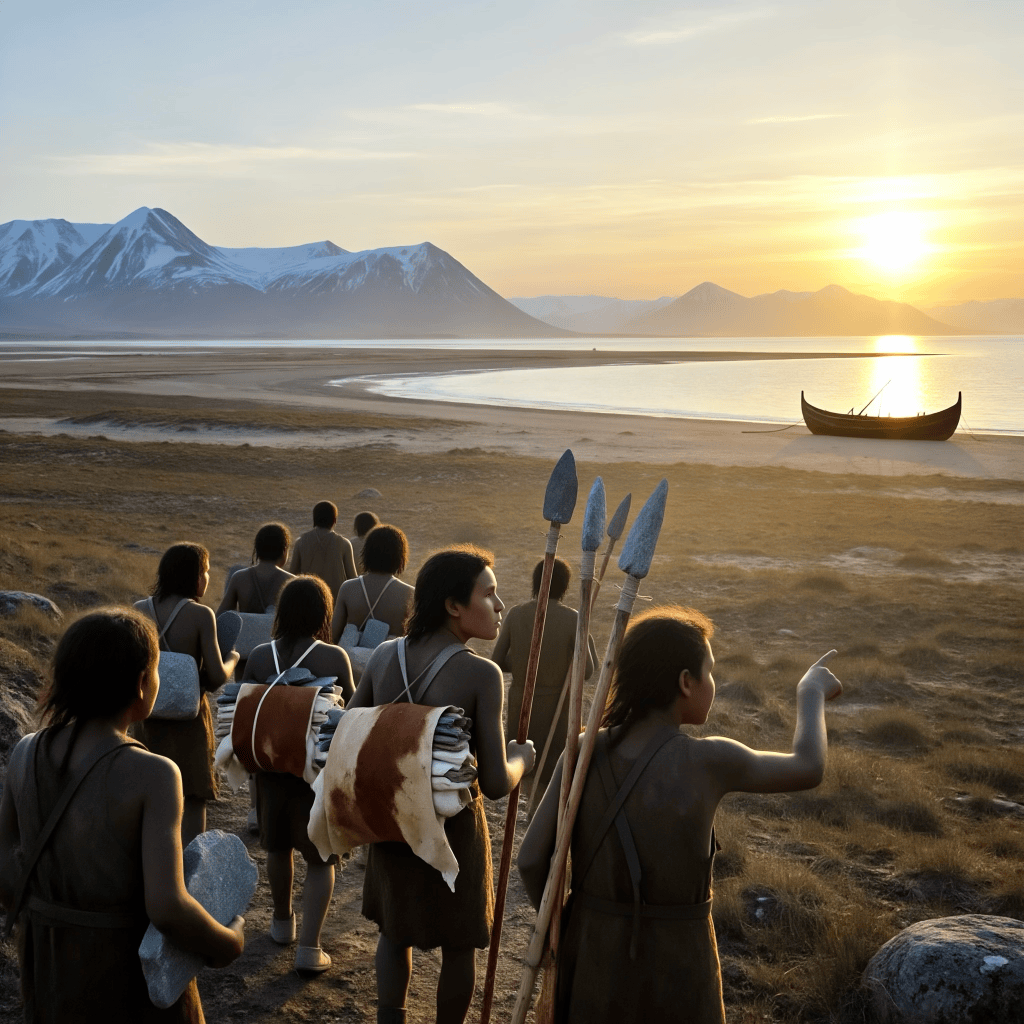
The Cognitive Revolution did not only change how humans communicated.
It changed what humans were capable of doing collectively.
Homo sapiens began spreading into environments that had previously been inhabited by other animals and human species.
Humans eventually reached places such as Australia, requiring the ability to cross significant stretches of water.
This is important because migration on this scale requires more than individual intelligence.
It requires:
planning + cooperation + knowledge + technology + communication.
One person cannot colonize a continent alone.
A group can.
And groups can coordinate because they share information.
The same underlying ability that helps a small group organize a hunt can eventually help humans organize migrations across continents.
12. The Dark Side of Human Expansion
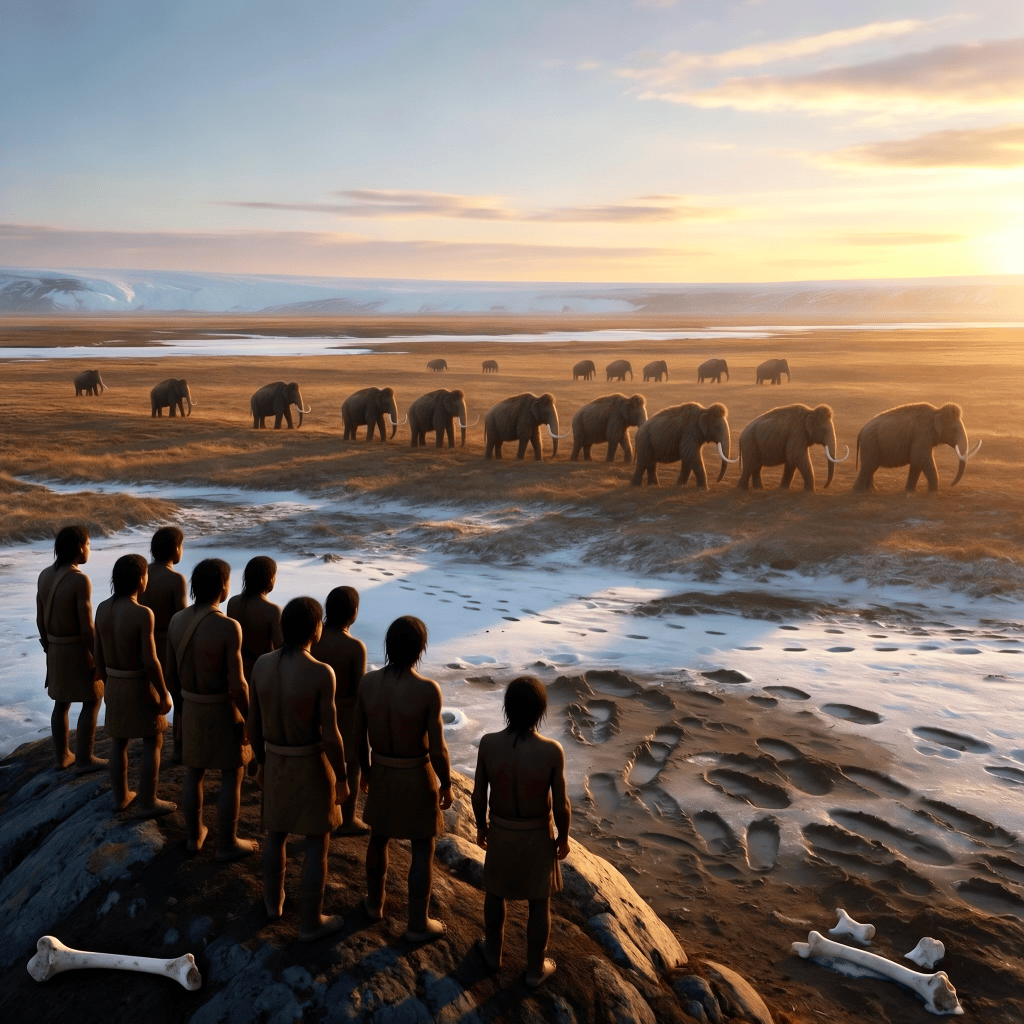
But there is another side to the story.
Human success was not always harmless.
As Homo sapiens spread into new environments, many large animal species disappeared.
This pattern is particularly associated with the arrival of humans in regions that had previously lacked human hunters, although climate change and other environmental factors also played roles in many extinctions.
Harari calls attention to this pattern because it challenges a comforting idea:
Human progress and environmental destruction are not necessarily separate stories.
Our ability to cooperate gave us enormous power.
But power does not automatically mean wisdom.
The same intelligence that allows humans to create new tools can also allow humans to exploit ecosystems more effectively.
The same cooperation that allows people to build communities can allow them to organize large-scale destruction.
This is an important theme that continues throughout Sapiens:
Human success can produce both extraordinary creation and extraordinary destruction.
13. Why the Cognitive Revolution Matters So Much
At first glance, the Cognitive Revolution might sound like a story about language.
But it is much bigger than that.
It is a story about collective intelligence.
Imagine one human discovering how to make a particular tool.
If that knowledge dies with the individual, its impact is limited.
But imagine that the knowledge can be explained to ten people.
Those ten people teach others.
The next generation modifies the technique.
Someone combines it with another invention.
Another person improves it.
Knowledge begins accumulating across generations.
This is where human culture becomes extraordinarily powerful.
Genes change relatively slowly.
Ideas can change much faster.
A new idea can spread through a population within years, months or even days.
That gives humans another evolutionary advantage:
we can adapt through culture without waiting for biological evolution.
14. Culture Became a Second Evolutionary System
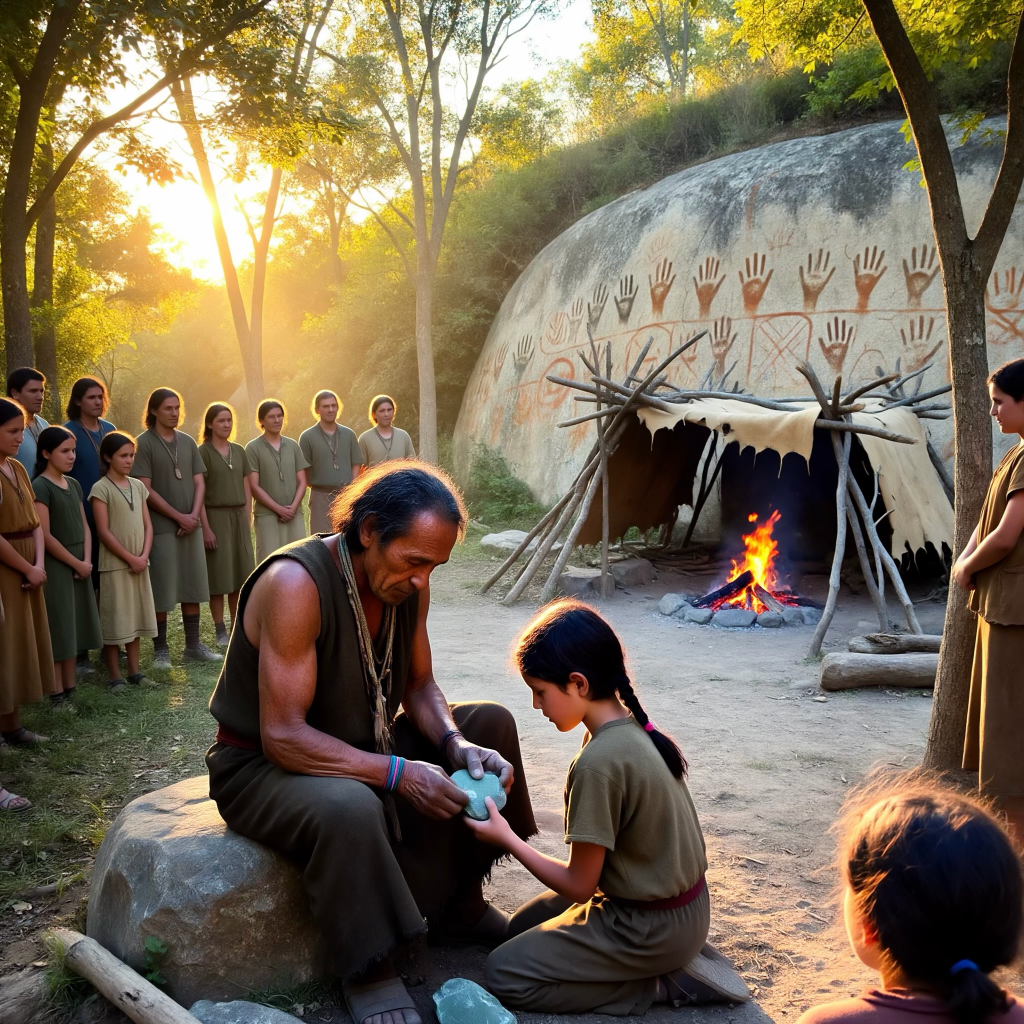
Biological evolution works through changes in genes across generations.
Cultural evolution works through the transmission of ideas, behaviors and knowledge.
Imagine two groups facing the same environmental problem.
Group A develops a better hunting technique.
Group B doesn’t.
The advantage can spread through learning.
Nobody needs to wait thousands of years for a genetic mutation.
Someone can simply say:
“Try it this way.”
This ability to learn from one another allows humans to accumulate knowledge.
And cumulative knowledge is incredibly powerful.
A single human being has limited intelligence.
But a society can effectively combine the knowledge of thousands, millions or billions of individuals.
That is one reason human civilization can achieve things that no individual human could ever accomplish alone.
15. The Most Important Idea: Cooperation at Scale
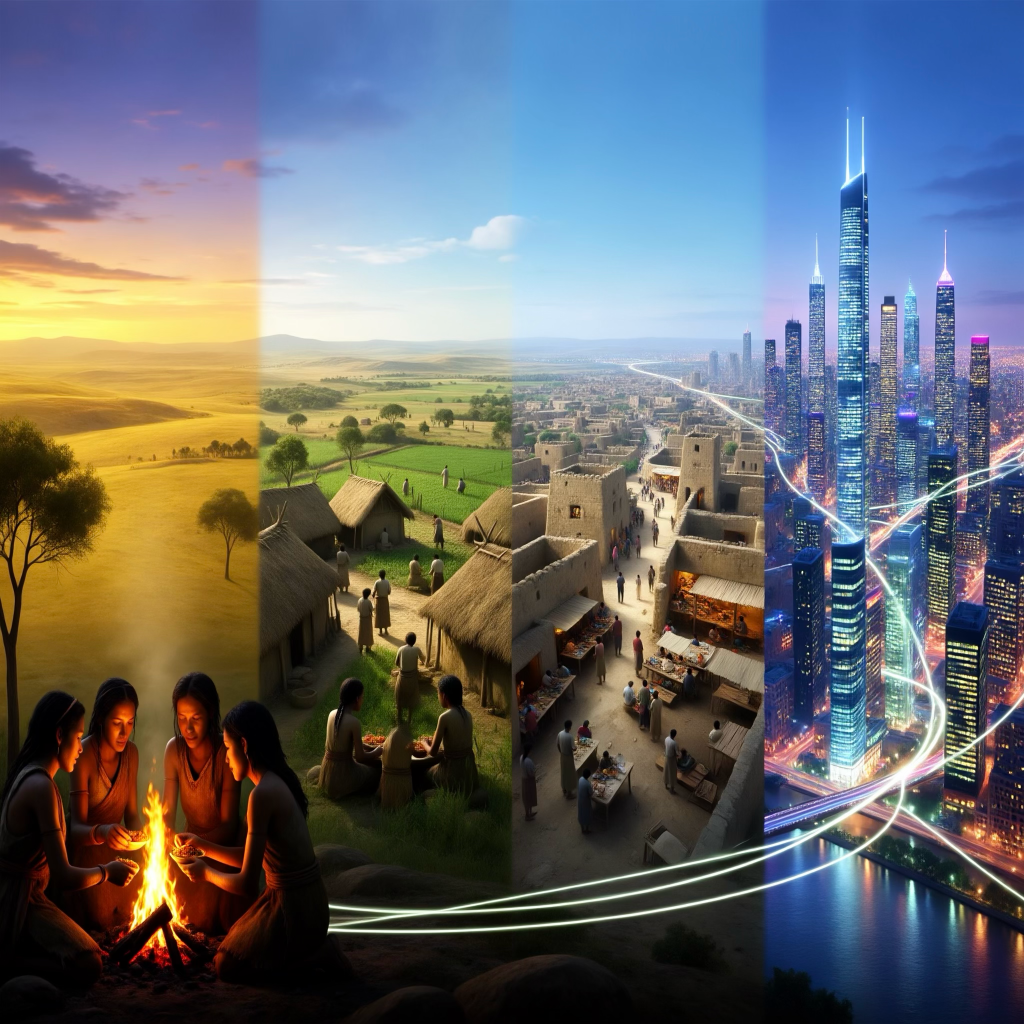
If you remember only one idea from Part One of Sapiens, remember this:
Human power comes less from individual strength and more from our ability to cooperate flexibly in large numbers.
A lion is physically stronger than a human.
But a lion cannot create a global airline.
A chimpanzee is physically capable and socially intelligent.
But chimpanzees cannot create a multinational corporation.
A human can sit in a room in Delhi and transfer money to someone in Tokyo whom they have never met.
Why?
Because both people participate in shared systems.
They recognize money.
They recognize institutions.
They follow rules.
They use language.
They trust systems created by countless other humans.
This is the hidden infrastructure of civilization.
16. But Are Shared Stories “Fake”?

This is where Harari’s argument can easily be misunderstood.
When he describes things like nations, money or corporations as imagined realities, he is not simply saying:
“They are fake, so they don’t matter.”
In fact, the opposite is closer to the point.
Something can be socially constructed and still have enormous real-world consequences.
A border may be an invisible line on the ground.
But crossing it can determine whether you need a passport.
Money is based on collective recognition.
But losing your money can have very real consequences.
A legal contract consists of words.
But breaking it can lead to a court case.
A university degree is a social institution.
But it can influence someone’s career.
So the important question is not:
“Is it physically real?”
The better question is:
“What happens when millions of people collectively treat it as real?”
That is the extraordinary power of shared human beliefs.
17. The Cognitive Revolution Changed What “Reality” Meant for Humans
Before the Cognitive Revolution, humans obviously had beliefs, communication and social relationships.
The important change was the increasing ability to create complex shared symbolic worlds.
Once humans could collectively imagine things, they could organize behavior around them.
A tribe could share a story about its ancestors.
A community could establish rituals.
A group could create rules.
A civilization could eventually create laws.
An empire could create a political identity.
A modern society can create corporations, currencies and institutions.
The complexity grows.
But the underlying mechanism remains surprisingly similar:
shared information → shared belief → coordinated behavior → collective power.
18. What Can We Learn From the Cognitive Revolution Today?
This is where Sapiens becomes more than a history book.
It becomes a way of looking at the modern world.
Think about your own life.
How many things around you exist because people collectively believe in them?
Your job title.
Your university degree.
Your country’s borders.
Your bank balance.
Your company’s existence.
Your social status.
The value of a currency.
The rules of a game.
The concept of a brand.
None of these are trees or mountains.
They are systems of shared meaning.
And yet they can strongly influence what people do.
This doesn’t mean that everything is imaginary or that facts don’t matter.
It means that humans operate simultaneously in the physical world and in a huge network of social meanings.
Understanding that distinction helps explain why societies can become so powerful—and why they can also change so dramatically.
19. The Strange Power of Belief
Consider a simple example.
Suppose 100 people are standing in a field.
One person draws an invisible line and says:
“This is the border.”
Physically, nothing has changed.
The soil is the same.
The trees are the same.
The air is the same.
But if all 100 people accept the rule, behavior changes.
Now imagine millions of people accepting the same idea.
The consequences become enormous.
This is how human societies transform abstract ideas into institutions.
The idea itself may begin in someone’s imagination.
But collective agreement can turn it into something with physical consequences.
That is one of the deepest insights of the Cognitive Revolution.
20. The Big Question: Did Intelligence Make Us Powerful?
Not exactly.
At least, intelligence alone doesn’t explain human dominance.
Many animals are intelligent.
The more useful question is:
What did humans do with their intelligence?
We communicated.
We learned from one another.
We created shared symbols.
We transmitted knowledge.
We formed groups.
We coordinated behavior.
We created stories.
And eventually, those stories allowed increasingly large numbers of strangers to cooperate.
That combination created something unusual in the history of life:
a species whose greatest strength exists between individuals rather than inside individuals.
One human is relatively weak.
A coordinated group of humans can transform an ecosystem.
A coordinated society can build a city.
A coordinated civilization can build an aircraft carrier, a space telescope or a global digital network.
The power is collective.
21. The Cognitive Revolution Wasn’t the End of the Story
The Cognitive Revolution gave humans extraordinary abilities.
But it also created a problem.
Once humans became capable of cooperating in large numbers, they could build increasingly complex societies.
And complex societies required new systems.
How would thousands of people organize food?
Who would own land?
Who would make decisions?
How would people remember agreements?
How would societies organize labor?
How would communities maintain order?
These questions eventually pushed humans toward another enormous transformation.
Agriculture.
And that brings us to the next part of Sapiens.
What Part One of Sapiens Really Teaches Us
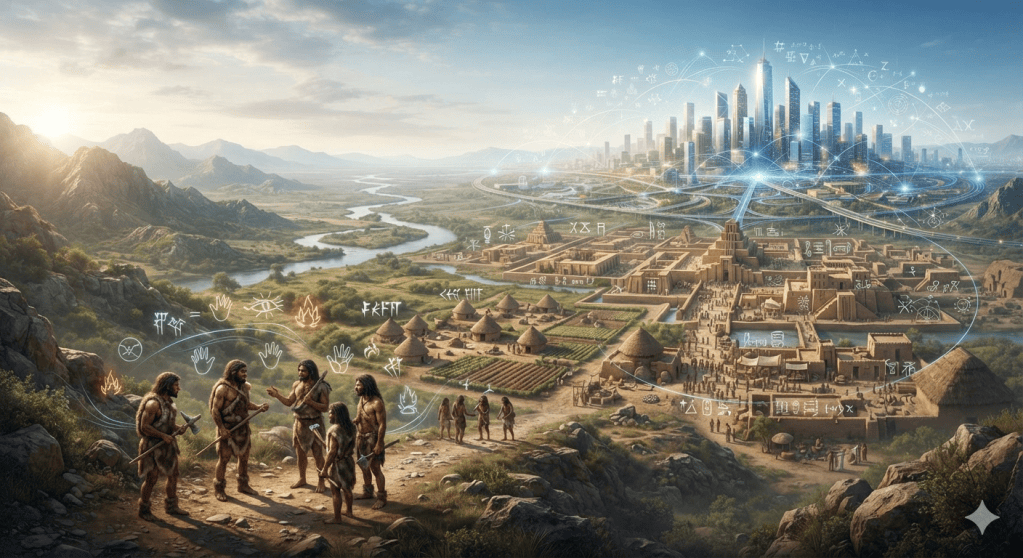
The Cognitive Revolution is not simply a story about prehistoric humans suddenly becoming intelligent.
It is a story about the emergence of a new kind of human power.
We became powerful because we could share information, preserve knowledge, imagine possibilities and coordinate our behavior around common ideas.
Our ancestors could not individually overpower the natural world.
But collectively, they could.
And once humans learned to cooperate beyond the limits of personal relationships, the scale of what was possible changed dramatically.
The most important lesson may therefore be this:
Human civilization was built not by one extraordinary human, but by millions of ordinary humans who learned how to act together.
That ability eventually produced villages, cities, kingdoms, religions, empires, corporations and modern states.
But there was a hidden cost.
The more complex our shared systems became, the more dependent individuals became on them.
And the next revolution would transform human life even more dramatically.
Humans would stop following nature’s food supply.
They would begin controlling it.
Or, as Harari provocatively asks in the next part:
Did humans domesticate wheat—or did wheat domesticate humans?
Key Ideas to Remember
1. Homo sapiens was not always the dominant species.
Several human species once lived on Earth.
2. The Cognitive Revolution transformed human communication and cooperation.
Harari places it roughly 70,000 years ago.
3. Language became powerful because humans could communicate about more than immediate physical reality.
4. Shared stories allowed strangers to cooperate.
5. Culture can evolve much faster than biology.
6. Human power is largely collective.
One human is relatively weak; millions cooperating can reshape the planet.
7. Human expansion had environmental consequences.
The spread of humans was associated with the disappearance of many large animals, although the causes of individual extinctions can be complex.
8. Civilization depends heavily on shared systems of meaning.
9. Something can be socially constructed without being insignificant.
10. The Cognitive Revolution created the foundation for everything that followed.
A Question to Think About
Look around you.
Your money, job, university, country, company, passport, laws and social status all exist within systems that humans collectively recognize.
So ask yourself:
How much of the world I live in is physical—and how much exists because billions of people agree that it does?
That question is one of the best starting points for understanding Sapiens.
And perhaps it also explains something about the modern world:
Humans didn’t conquer the planet simply because they became stronger. They conquered it because they became exceptionally good at believing, communicating and cooperating together.


Leave a comment