Picture this: you’re standing in a coffee shop, staring at the menu. You order a latte instead of a cappuccino. Simple, right? You chose it.
But did you? Or was that choice the inevitable result of your mood, your last conversation, the smell of caramel from the pastry case, and a thousand tiny brain chemicals firing in a sequence set in motion long before you walked in?
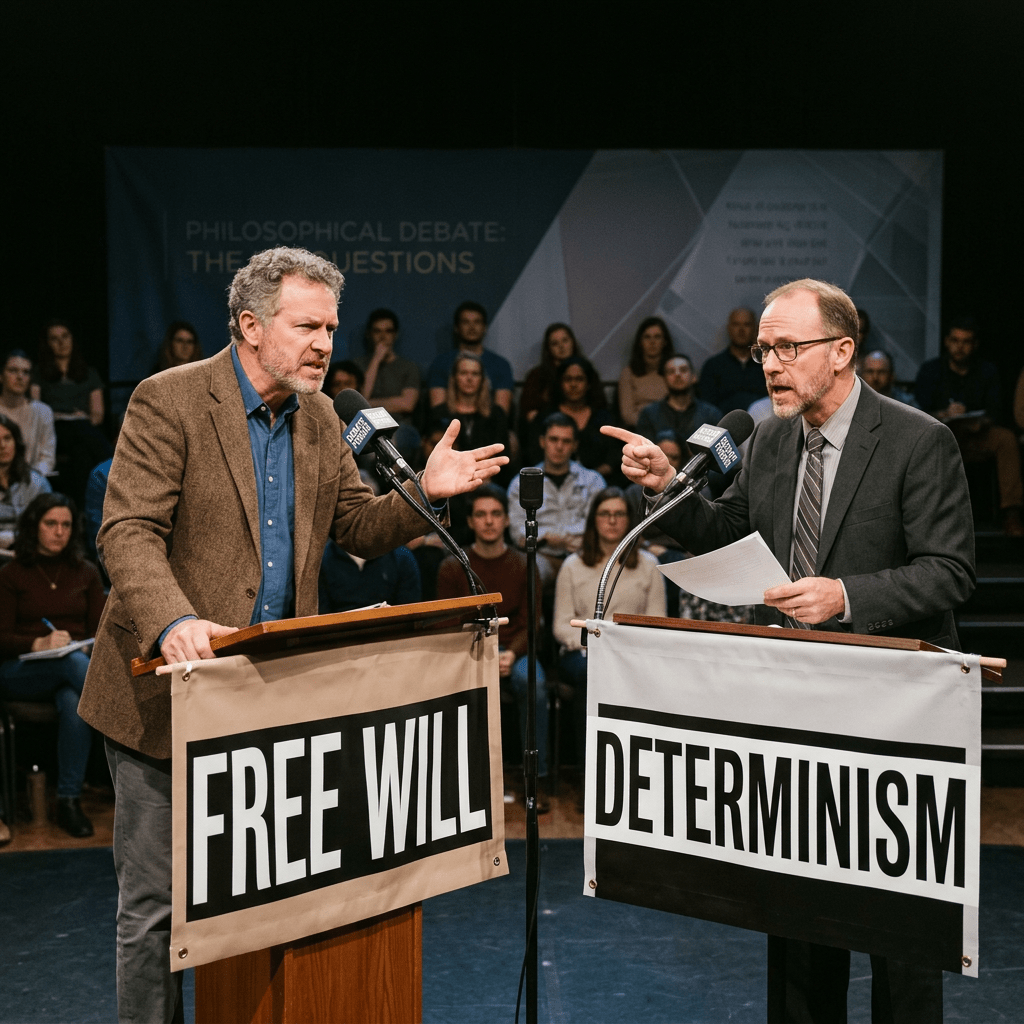
This is the heart of one of philosophy’s oldest and most mind-bending debates: free will vs. determinism.
The Case for Determinism
Determinism is the idea that every event — including every decision you make — is the result of prior causes. Nothing happens “out of nowhere.” Your genes, upbringing, environment, and even the position of atoms in your brain all combine to produce your next thought and action.
Under this view, the “you” who ordered the latte didn’t freely choose it. You were always going to order it, given everything that came before that moment. Rewind the universe and hit play again, and you’d order the exact same drink, every single time.
This isn’t just philosophical speculation — it has scientific backing too. Neuroscientists have found that brain activity related to a decision can sometimes be detected before a person becomes consciously aware they’ve made it. That’s unsettling. It suggests your brain might decide before “you” do.
The Case for Free Will
On the other side, free will is the belief that we genuinely author our choices. Yes, influences exist — but at the moment of decision, there’s a “you” doing the deciding, capable of going a different way.
Supporters of free will point out that determinism, taken to its extreme, seems to unravel things we deeply believe in: responsibility, morality, even the concept of justice. If a person can’t have done otherwise, can we really praise heroism or blame cruelty? Doesn’t punishment lose its meaning if criminals never truly could have chosen differently?
Free will feels obviously true from the inside. When you’re debating whether to send that risky text message or stay quiet, it feels like an open decision — not a scripted one.
The Middle Ground: Compatibilism
Many philosophers today land somewhere in between, in a position called compatibilism. The idea: free will and determinism aren’t actually enemies.
Compatibilists argue that free will doesn’t mean being uncaused — it means acting according to your own desires, reasoning, and values, without external coercion. If you order the latte because you wanted to, and nobody forced you, that’s “free” enough — even if your wanting was itself shaped by prior causes.
Think of it like this: a river is “determined” to flow downhill by gravity, but we’d still say the river is “free” if nothing is damming or diverting it. Maybe human freedom works the same way — not freedom from causes, but freedom within them.
Why This Debate Actually Matters

This isn’t just an academic exercise for people who like arguing in cafés. It shapes real questions:
- Justice systems — should punishment focus on retribution, or rehabilitation, if criminal behavior is largely shaped by upbringing and circumstance?
- Self-improvement — if your habits are the product of past conditioning, does that mean change is possible, or are you stuck?
- Relationships — how much should we blame people for how they react, versus understanding it as a product of their history?
Even if you never reach a final answer, wrestling with this question changes how you view yourself and others — often with more compassion.


Leave a comment