
What an ancient Greek philosopher can teach us about freedom, wealth, status, and the need for approval.
Imagine meeting one of the most powerful men in the ancient world—and being completely unimpressed by him.
Alexander the Great had conquered enormous territories and commanded armies capable of changing the map of the ancient world. Diogenes, meanwhile, owned almost nothing and had deliberately rejected the comforts and expectations of respectable society.
According to the famous story, Alexander approached Diogenes and asked whether there was anything he could do for him.
Diogenes supposedly looked at the powerful ruler and simply asked him to move because he was blocking the sunlight.
Whether every detail of that encounter is historically accurate is difficult to establish. But the story captures something essential about Diogenes of Sinope.
He had built his entire life around a radical idea:
You become freer when you stop needing the things society tells you that you need.
Diogenes was one of the most famous figures associated with Cynicism, an ancient Greek philosophical movement that challenged conventional ideas about wealth, reputation, comfort, and social status.
His lifestyle was extreme. His behavior was often deliberately shocking. But beneath the provocation was a serious philosophical question:
How much of what we pursue do we actually need—and how much do we pursue simply because everyone else does?
Who Was Diogenes?
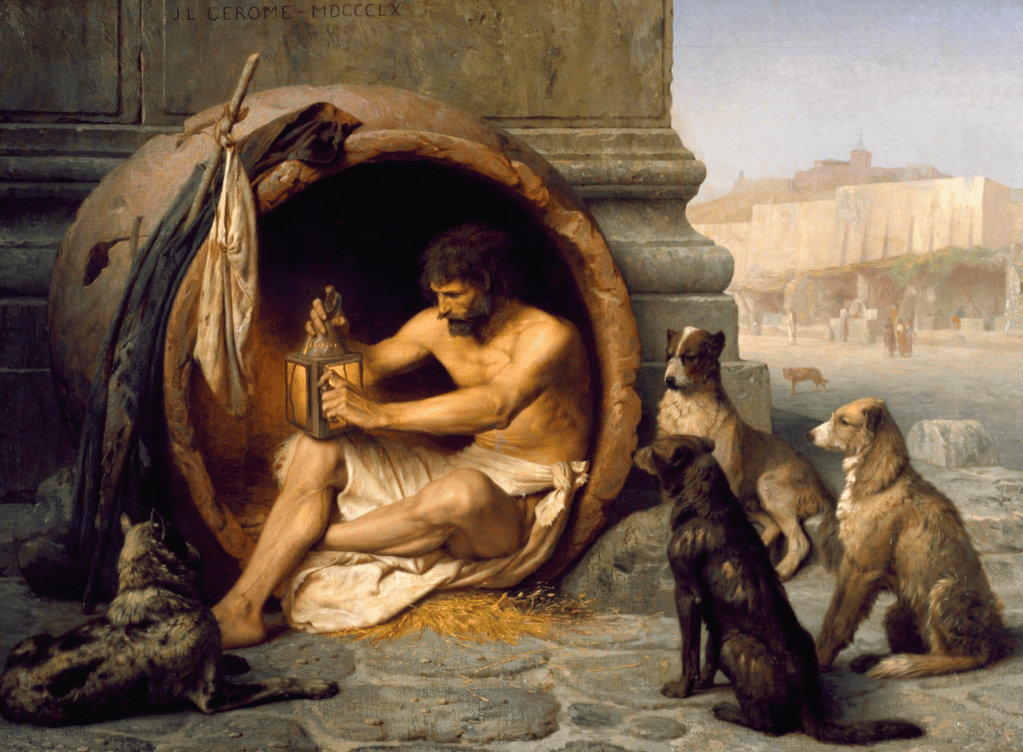


Diogenes of Sinope was a Greek philosopher who lived around the 4th century BCE.
He is generally associated with the Cynic school of philosophy, although the historical details of his life are surrounded by stories, anecdotes, and later accounts.
Unlike philosophers who became famous for writing elaborate theories, Diogenes became famous for something very different:
He turned philosophy into a way of life.
He rejected many of the things that people normally considered signs of success.
Wealth? He didn’t care for it.
Social status? He mocked it.
Luxury? He avoided it.
Conventional respectability? He frequently challenged it.
Instead, Diogenes emphasized self-sufficiency, simplicity, freedom, and living according to nature rather than social convention.
His philosophy wasn’t simply:
“Don’t own things.”
It was closer to:
“Don’t become dependent on things.”
That distinction is important.
What Was Cynicism?
To understand Diogenes philosophy, we first need to understand Cynicism.
The ancient Cynics believed that many human problems came from artificial social conventions.
People spend their lives chasing:
- Wealth
- Fame
- Power
- Luxury
- Reputation
- Social approval
- Political influence
But the Cynics questioned whether these things actually make people happy.
Their alternative was surprisingly simple.
They believed people should cultivate virtue and self-sufficiency while reducing their dependence on unnecessary possessions and social expectations.
The word “Cynicism” comes from the Greek word kynikos, associated with a dog.
This was not necessarily an insult in the way we understand “cynical” today. The Cynics embraced the comparison because dogs were seen as living naturally and without the artificial shame and conventions that humans imposed upon themselves.
Modern cynicism—meaning distrust of people’s motives—is therefore quite different from ancient Cynicism.
Ancient Cynicism was a philosophical lifestyle.
And Diogenes became its most famous—and most outrageous—representative.
Diogenes and the Rejection of Wealth
One of the central ideas in Diogenes philosophy was that wealth can create dependence rather than freedom.
Imagine two people.
One owns a huge house, expensive clothes, several cars, and countless possessions.
The other owns almost nothing.
At first glance, the wealthy person appears more powerful.
But Diogenes might ask a different question:
Who actually needs more?
The wealthy person may need money to maintain the house, protect the possessions, maintain the lifestyle, and preserve their social position.
The person who needs almost nothing can lose almost nothing.
This is where Diogenes’ philosophy becomes surprisingly relevant today.
Modern society often equates having more with being more successful.
A bigger house.
A better car.
A higher salary.
More followers.
More expensive clothes.
More achievements.
But Diogenes would challenge the assumption that more automatically means better.
His question would probably be:
At what point do your possessions begin to possess you?
Diogenes and the Power of Not Caring


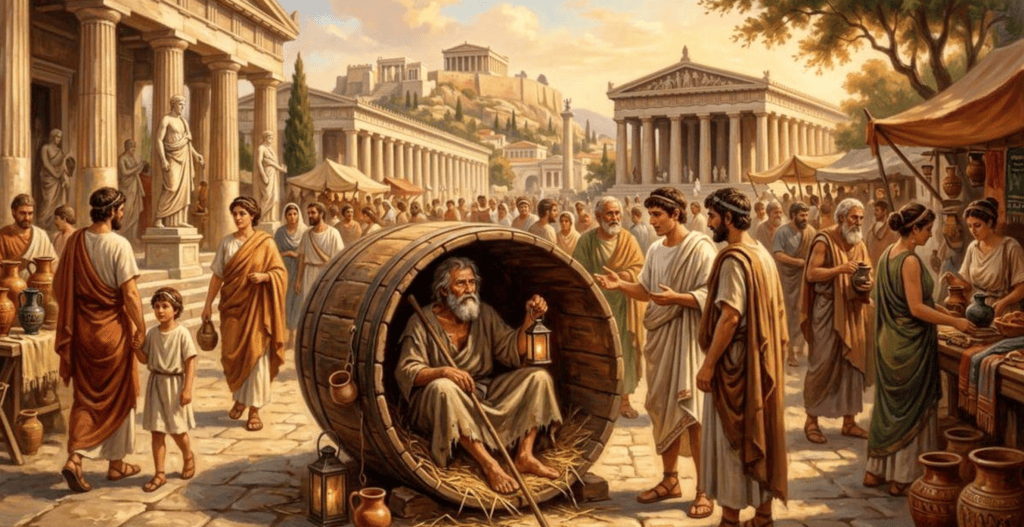
Perhaps the most radical aspect of Diogenes wasn’t his lack of possessions.
It was his apparent lack of concern for what other people thought about him.
He deliberately violated social expectations.
He mocked powerful people.
He questioned conventional manners.
He challenged people publicly.
He was willing to look ridiculous if it meant exposing what he considered ridiculous behavior in society.
This connects directly to one of the most powerful ideas in his philosophy:
Social approval can become a form of slavery.
Think about how often people change their behavior because they are worried about judgment.
We choose careers partly because they sound impressive.
We buy clothes partly because of how they will be perceived.
We post photographs hoping people will react positively.
We compare our lives with people we barely know.
We sometimes make decisions not because we want something, but because we want other people to believe we want it.
Diogenes would likely see this as a serious loss of freedom.
If your happiness depends upon the opinions of others, you have given those people control over your happiness.
Diogenes and Alexander the Great

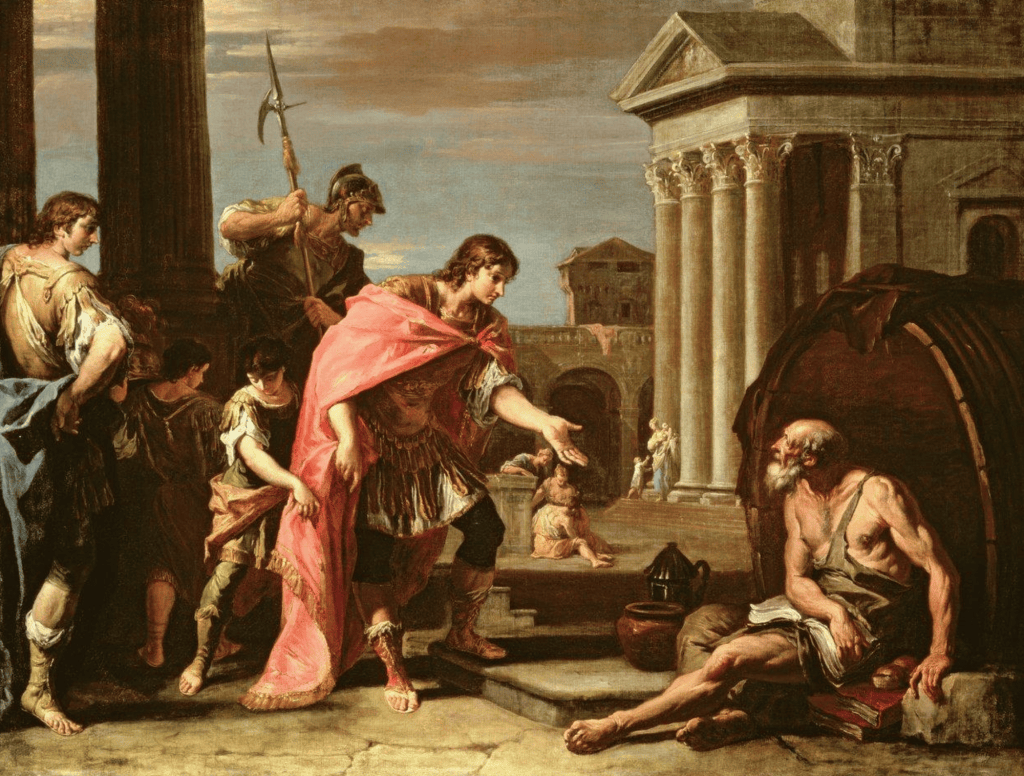

The story of Diogenes and Alexander the Great is perhaps the most famous anecdote associated with the philosopher.
According to the traditional account, Alexander visited Diogenes and offered to grant him whatever he wanted.
Diogenes supposedly replied by asking Alexander to move because he was blocking the sunlight.
Alexander was reportedly impressed by the philosopher’s independence.
The story is powerful because the two men represented almost opposite ideas of greatness.
Alexander wanted the world.
Diogenes wanted nothing from the world.
Alexander accumulated territory, wealth, soldiers, and political power.
Diogenes attempted to eliminate his dependence on wealth, status, and authority.
The encounter therefore creates an interesting philosophical question:
Who was actually more powerful?
Alexander could command armies.
But Diogenes could supposedly look at Alexander and say, essentially:
“I don’t need anything you have.”
And that is a different kind of power.
Did Diogenes Really Live in a Barrel?
One of the most famous images of Diogenes is that of a philosopher living inside a barrel.
The story is commonly repeated today, but the ancient sources are more complicated. Diogenes is traditionally said to have lived in a large ceramic storage vessel, often translated into English as a “barrel.”
The important point isn’t really the object itself.
It represents his rejection of conventional ideas about comfort and respectable living.
While other people pursued houses, possessions, and social status, Diogenes demonstrated that a person could survive with remarkably little.
His lifestyle was intended to prove something:
Many of the things we consider necessities are actually preferences that society has taught us to treat as necessities.
The Famous Lantern Story
Another famous story says that Diogenes walked through Athens during the day carrying a lantern.
When people asked what he was doing, he reportedly said that he was looking for a human being.
The story was meant as an insult.
Diogenes wasn’t literally claiming that Athens contained no humans.
He was criticizing the behavior of people around him.
In his view, simply being biologically human wasn’t enough.
A genuinely good human being should possess virtue, honesty, independence, and self-control.
The story therefore reflects another important principle of Cynic philosophy:
Don’t confuse social success with moral success.
Someone can be wealthy and still be miserable.
Someone can be powerful and still be cowardly.
Someone can be famous and still lack character.
Someone can be respected by society and still live a life that is deeply unfree.
Diogenes wanted people to examine that difference.
Diogenes and the Idea of Freedom
Freedom is perhaps the most useful way to understand Diogenes philosophy.
Most people define freedom as having more choices.
Diogenes offered another possibility:
Freedom can also mean needing fewer things.
Suppose you need expensive possessions to feel successful.
Then you need money.
If you need money, you need a job.
If you need a particular job, you may become dependent upon your employer.
If your identity depends on status, you become dependent upon other people’s opinions.
The chain continues.
Diogenes attempted to break that chain.
He wanted to become self-sufficient.
The less he needed from society, the less power society had over him.
This idea later became important in different forms within Stoicism and other philosophical traditions.
Why Diogenes Was So Provocative
Diogenes wasn’t simply trying to be eccentric.
His provocative behavior served a philosophical purpose.
He believed that people often lived according to rules they had never questioned.
So he questioned them publicly.
Why must we behave this way?
Why do we care about status?
Why do we need luxury?
Why should wealth determine someone’s worth?
Why should social conventions control our lives?
By behaving in shocking ways, Diogenes forced people to confront assumptions they normally ignored.
His philosophy was therefore partly performance.
He didn’t just explain his ideas.
He acted them out.
Diogenes Wasn’t Saying Everyone Should Become Homeless
It would be easy to misunderstand Diogenes.
His philosophy shouldn’t simply be reduced to:
“Material possessions are bad.”
That’s too simplistic.
The deeper question is about attachment and dependence.
Having a house doesn’t automatically make someone unfree.
Having money doesn’t automatically make someone unhappy.
Enjoying comfort isn’t inherently immoral.
The problem begins when external things become necessary for your sense of worth or happiness.
Diogenes asks us to examine our relationship with those things.
Do you own your possessions?
Or do your possessions own you?
Do you use money?
Or does money determine your entire life?
Do you enjoy social approval?
Or can you remain confident without it?
That is where his philosophy becomes much more interesting.
What Diogenes Can Teach Us Today


Diogenes lived more than two thousand years ago, but many of his questions feel surprisingly modern.
1. You Don’t Need Everyone’s Approval
Social media has made public approval easier to measure than ever.
Likes.
Followers.
Comments.
Views.
Shares.
It can become tempting to judge yourself through numbers.
Diogenes would probably find this strange.
His philosophy suggests that your value should not depend upon an audience.
2. More Isn’t Always Better
Modern consumer culture constantly encourages us to upgrade.
New phone.
New car.
New clothes.
Bigger house.
More expensive experiences.
But acquiring more also creates more responsibility.
Diogenes reminds us to ask:
Will this actually improve my life, or will it simply increase what I have to maintain?
3. Learn to Be Comfortable With Less
You don’t have to abandon modern life to apply Diogenes’ philosophy.
You could simply practice wanting less.
Spend less.
Compare yourself less.
Buy things more intentionally.
Take breaks from social media.
Learn to enjoy your own company.
The goal isn’t poverty.
The goal is independence from unnecessary desire.
4. Question the Definition of Success
Society gives us a standard formula:
Education → Career → Money → Status → More Money → More Status.
But Diogenes would probably interrupt the formula and ask:
“And then what?”
What is the point of becoming successful if you never actually become free?
What is the point of impressing everyone else if you don’t respect the person you have become?
These questions are uncomfortable precisely because they don’t have easy answers.
Was Diogenes a Cynic, a Stoic, or Something Else?
Diogenes was primarily associated with Cynicism, not Stoicism.
However, Cynicism influenced later Stoic philosophy.
The Stoics also emphasized ideas such as self-control, resilience, virtue, and reducing dependence on external circumstances.
But there were important differences.
Diogenes and the Cynics were generally far more confrontational toward social conventions. They used public behavior and provocation as philosophical tools.
Stoicism eventually developed into a much broader philosophical system concerning ethics, reason, emotions, and our relationship with events beyond our control.
So while Diogenes isn’t technically a Stoic, there is a philosophical connection between the traditions.
The Real Lesson of Diogenes
Perhaps the most important lesson of Diogenes isn’t that we should live in a barrel.
It isn’t that wealth is evil.
It isn’t even that society is always wrong.
His deeper lesson is much harder:
Examine what you think you need.
We often assume our desires are natural.
But many of them are learned.
We learn what success is supposed to look like.
We learn what kind of house we should want.
We learn what kind of career sounds impressive.
We learn what clothes are considered fashionable.
We learn how many followers make someone important.
And because everyone around us seems to want the same things, we rarely stop to ask whether we want them ourselves.
Diogenes did.
He stripped away as much as possible and asked a brutally simple question:
What do I actually need to live a good life?
His answer was radically small.
And that is precisely why his philosophy remains so provocative.
Diogenes’ Philosophy in One Sentence
If we had to reduce the philosophy of Diogenes to a single idea, it might be this:
The fewer unnecessary things you need to be happy, the harder you are to control.
That doesn’t mean abandoning ambition.
It means understanding the difference between wanting something and needing it to feel worthy.
You can pursue wealth without worshipping it.
You can enjoy luxury without depending on it.
You can appreciate recognition without requiring it.
You can participate in society without allowing society to completely define you.
And perhaps that is the modern version of Diogenes’ challenge:
Live in the world—but don’t let the world decide what you need.
Frequently Asked Questions About Diogenes
Who was Diogenes?
Diogenes of Sinope was an ancient Greek philosopher associated with the Cynic school of philosophy. He became famous for rejecting wealth, status, conventional social behavior, and unnecessary possessions.
What was Diogenes’ philosophy?
Diogenes philosophy emphasized self-sufficiency, simplicity, virtue, freedom from social conventions, and reducing dependence on wealth and material possessions.
Why did Diogenes live in a barrel?
Ancient accounts describe Diogenes as living in a large ceramic vessel, commonly translated as a barrel. His simple living symbolized his rejection of conventional ideas about comfort, wealth, and status.
What did Diogenes say to Alexander the Great?
According to a famous ancient anecdote, when Alexander offered to grant Diogenes a request, Diogenes asked him to move because he was blocking the sunlight. The story symbolizes Diogenes’ indifference to political power and wealth.
Was Diogenes a Stoic?
No. Diogenes was a Cynic philosopher. However, Cynicism strongly influenced the later development of Stoicism, and the two traditions share ideas about virtue, self-control, and independence from external circumstances.
Why is Diogenes important today?
Diogenes remains relevant because he challenged ideas that are still central to modern life: consumerism, social status, wealth, reputation, and the desire for approval. His philosophy encourages people to question what they genuinely need to live a fulfilling life.
What can we learn from Diogenes?
One of the central lessons is that freedom can come from needing less. Diogenes encourages us to question social expectations and avoid allowing possessions, wealth, or other people’s opinions to determine our happiness.
Final Thoughts
Diogenes lived more than two thousand years ago.
He had no social media account, no luxury apartment, no expensive car, and no interest in building a conventional career.
Yet people are still talking about him.
Maybe that’s because his question hasn’t disappeared.
We are still chasing things.
Still comparing ourselves.
Still seeking approval.
Still confusing wealth with success.
Still wondering whether we are living the life we actually want—or simply the life we’ve been taught to want.
Diogenes’ answer was extreme.
But perhaps his question is worth keeping:
If you removed everything you were told you needed, what would you still want?
And maybe that is where freedom begins.


Leave a comment