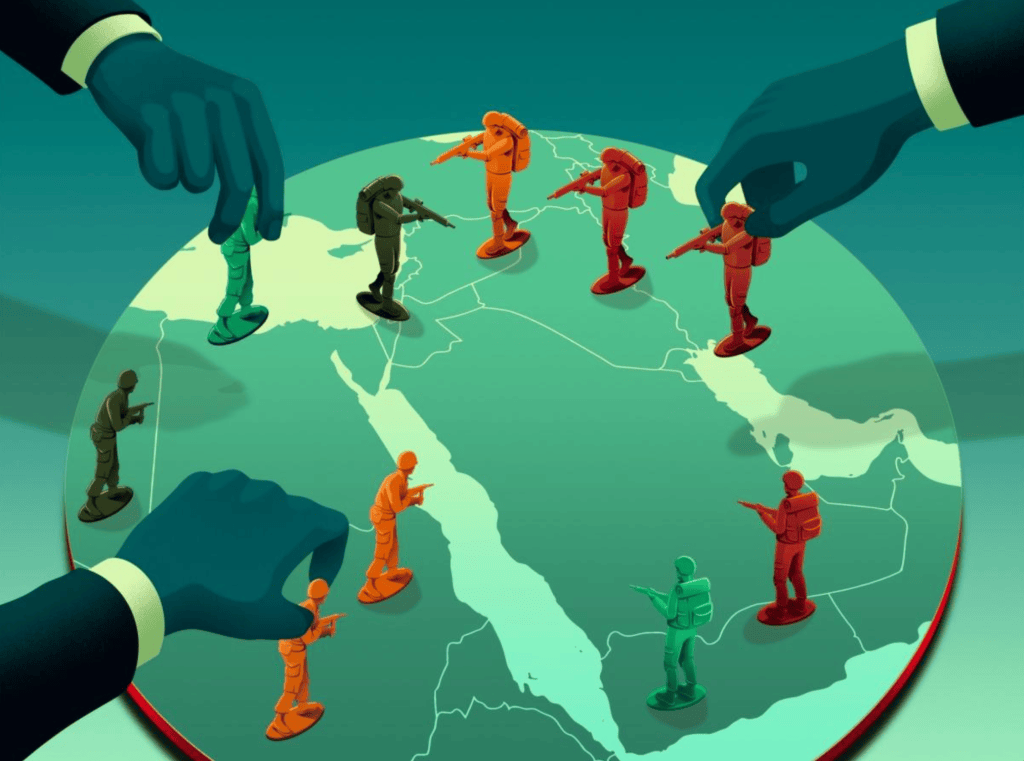
Imagine two rival gang leaders who both know that fighting each other directly could destroy everything they’ve built — their money, reputation, and perhaps even their lives.
So instead of fighting each other, they each back a smaller crew.
They provide money, weapons, information, and protection. The smaller crews do the actual fighting, while the two leaders try to avoid a direct confrontation.
That is the basic idea behind a proxy war.
A proxy war happens when powerful countries or other outside actors support opposing sides in a conflict instead of fighting each other directly. They may provide weapons, money, military training, intelligence, or logistical support while local forces do most of the fighting.
Once you understand how proxy wars work, many complicated international conflicts become easier to understand.
What Is a Proxy War?
A proxy war is a conflict in which outside powers support opposing sides in an ongoing war or conflict without directly fighting each other on the battlefield.
The outside powers are sometimes called sponsors, while the groups receiving their support can be described as proxies.
Support can take many forms, including:
- Weapons and ammunition
- Military training
- Intelligence and surveillance
- Financial assistance
- Drones and other military equipment
- Logistical support
- Political and diplomatic backing
A conflict does not necessarily have to be created by outside powers to become a proxy war. A local civil war, insurgency, or regional conflict can gradually become part of a much larger international rivalry when foreign powers begin supporting different sides.
And that’s where proxy wars become complicated.
In simple terms: A proxy war is a conflict in which outside powers support opposing groups instead of fighting each other directly. They may provide weapons, money, training, intelligence, or other assistance.
Why Do Countries Fight Proxy Wars?
If countries can simply send their own armies into battle, why would they fight indirectly?
There are several reasons.
1. It reduces the risk of direct confrontation
The biggest reason is often escalation.
If two powerful countries fight each other directly, the consequences can be enormous. The danger becomes even greater when the countries involved possess nuclear weapons.
Supporting another force allows a country to compete with an adversary while creating some distance between its own military and the battlefield.
2. Proxy wars can be cheaper
Maintaining a large military operation is enormously expensive.
Providing weapons, money, intelligence, or training to a local partner can allow a country to pursue strategic goals without bearing the entire cost of a conventional war.
3. It creates political distance
A country can sometimes deny or minimize its involvement when its forces are not openly fighting on the ground.
This does not necessarily mean its involvement is secret. Weapons shipments, intelligence cooperation, and military assistance can be publicly known while the sponsoring country still avoids direct combat.
4. It allows countries to compete for influence
Proxy wars are not always only about defeating an enemy.
They can also be about gaining influence over strategically important regions, governments, trade routes, military bases, or resources.
This is why a relatively small local conflict can sometimes attract the attention — and resources — of much larger powers.
How Does a Proxy War Work?
A typical proxy conflict can develop through several stages.
Local conflict → Foreign involvement → Outside support → Escalation → International rivalry
Imagine a country experiencing a civil war.
One faction receives weapons and funding from Country A.
Its opponent receives weapons, intelligence, or financial support from Country B.
The original conflict is still local, but it now has an international dimension.
Country A and Country B may have completely different strategic objectives from the people actually fighting on the ground.
That creates one of the biggest problems with proxy wars: the local fighters and their foreign sponsors may not want the same thing.
Proxy War Examples
Proxy warfare has appeared throughout modern history, but several current and recent conflicts demonstrate how complicated the concept can become.
1. Ukraine: A War With Elements of Proxy Conflict
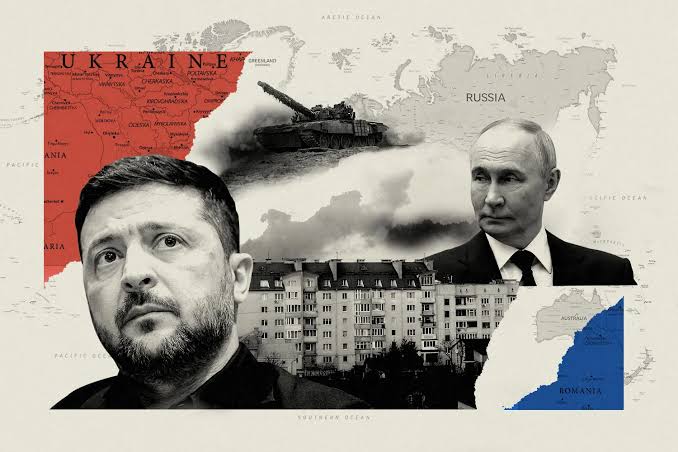
The war in Ukraine is first and foremost a war between Russia and Ukraine. Russia launched its full-scale invasion of Ukraine in February 2022, and Ukraine has been fighting to defend its territory.
At the same time, the conflict has developed a major international dimension.
The United States and European countries have provided Ukraine with weapons, financial assistance, intelligence, training, and other forms of support while generally avoiding sending their own combat forces to fight Russian troops directly.
Russia, meanwhile, has received varying forms of military and economic support from countries including Iran and North Korea, while China has provided important economic and diplomatic support and has been accused by Western governments of contributing to Russia’s war capacity.
Because of this, analysts sometimes describe the war as having elements of proxy warfare.
However, calling Ukraine simply a “proxy war” can be misleading.
Ukraine has its own government, military, national interests, and independent reasons for fighting. It is not merely fighting on behalf of another country.
That distinction matters.
2. Yemen: A Local War With Regional Rivalries
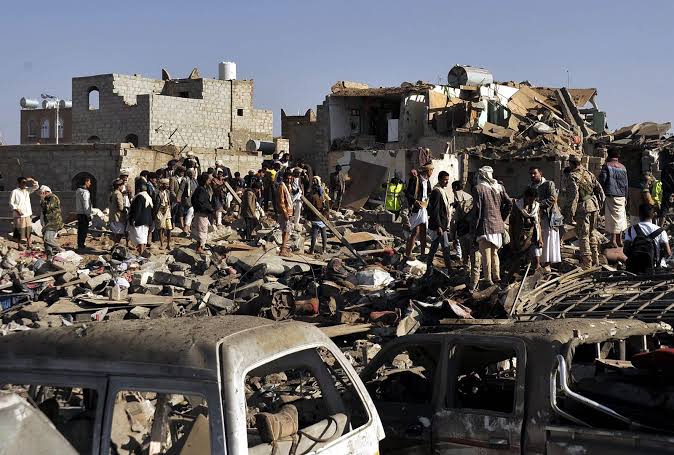
Yemen provides another important example of how a local conflict can become internationalized.
The conflict escalated dramatically in 2014 when the Houthi movement seized control of large parts of the country, including the capital, Sana’a.
Saudi Arabia subsequently led a military coalition supporting Yemen’s internationally recognized government, while Iran provided significant support to the Houthis.
The conflict therefore became intertwined with the broader rivalry between Saudi Arabia and Iran.
But Yemen’s war cannot be reduced to simply “Saudi Arabia versus Iran.”
There are multiple Yemeni factions, political interests, tribal relationships, and regional actors involved.
The United Arab Emirates, for example, has supported forces in Yemen whose interests have not always aligned perfectly with those of Saudi Arabia.
This illustrates an important characteristic of proxy wars:
There are often more than two sides.
A country can simultaneously be fighting a local conflict, a regional power struggle, and a broader geopolitical competition.
3. Iran and Israel: Proxy Networks and the Shadow War
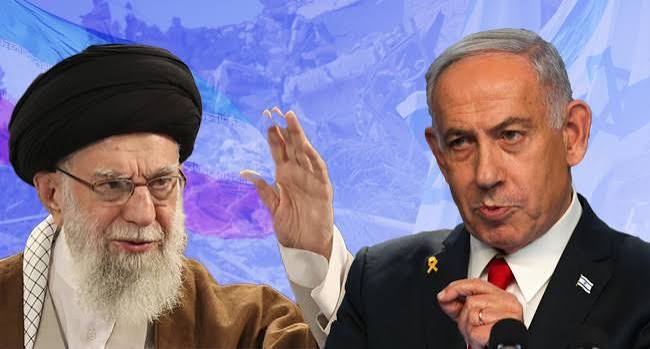
For decades, Iran and Israel have competed for influence and security across the Middle East.
Much of this confrontation has involved forces other than the Iranian and Israeli militaries.
Iran has supported groups and militias across the region, including Hezbollah in Lebanon and armed groups in Iraq and Syria, while the Houthi movement in Yemen has also received Iranian support.
Israel has repeatedly targeted Iranian military infrastructure, weapons transfers, and personnel in different parts of the region.
This created what is often described as a shadow war — a confrontation in which the two countries attempted to damage each other’s interests while avoiding a sustained conventional war between their own armies.
However, the distinction between proxy warfare and direct warfare is not always clear.
When states begin directly attacking one another, a conflict that previously relied heavily on proxies can move into a different and much more dangerous phase.
Proxy War vs. Direct War
So what is the difference between a proxy war and a direct war?
| Proxy War | Direct War |
|---|---|
| Outside powers support other forces | Countries’ own militaries fight each other |
| Support may include weapons, money and intelligence | Combat forces are directly involved |
| Sponsors may try to avoid direct escalation | Risk of direct escalation is much higher |
| Local groups usually do much of the fighting | National armed forces conduct the fighting |
The distinction isn’t always absolute.
Modern conflicts can contain both direct and indirect warfare at the same time.
A country might provide weapons to an ally while also conducting airstrikes itself. Another country might support a militia while simultaneously negotiating with its rival.
This is why describing a conflict as simply a “proxy war” can sometimes hide more than it explains.
Why Do Proxy Wars Last So Long?
One reason proxy conflicts can become prolonged is that foreign support can give local combatants access to resources they might otherwise lack.
Weapons arrive.
Money arrives.
Training continues.
Intelligence improves.
And the ability of the local forces to continue fighting increases.
But there is another problem: foreign sponsors may have different goals from the people actually fighting.
A local group may want control of a particular city or region.
A foreign sponsor may care about regional influence.
Another sponsor may care about weakening a rival.
The conflict can therefore continue even when a compromise might benefit the people living in the country where the fighting is taking place.
Who Pays the Price of a Proxy War?
This is perhaps the most uncomfortable part of proxy warfare.
The countries supporting opposing sides may not experience the destruction directly.
The people living where the fighting occurs do.
They can face:
- Death and injuries
- Displacement
- Destruction of homes and infrastructure
- Food shortages
- Economic collapse
- Disruption of healthcare and education
- Long-term political instability
This creates a fundamental imbalance.
The people making strategic decisions may be thousands of kilometres away from the people experiencing the consequences.
Are Proxy Wars Still Common Today?
Yes.
Proxy warfare remains an important feature of international politics.
But modern proxy wars don’t always look like traditional wars.
A foreign power may provide drones rather than conventional armies.
It may share satellite intelligence instead of deploying soldiers.
It may provide money, cyber capabilities, weapons, or military advisers.
Sometimes the relationship is openly acknowledged. Sometimes it is deliberately kept ambiguous.
This makes modern proxy conflicts harder to identify than the classic image of two countries simply supplying weapons to opposing armies.
Why Understanding Proxy Wars Matters
The next time you read about a civil war receiving weapons from a major international power, don’t look only at the two groups fighting on the ground.
Ask three questions:
Who is supporting each side?
What does each outside power want?
What happens if those outside powers stop providing support?
Those questions can reveal the geopolitical story underneath the battlefield.
A conflict that initially appears to be a local dispute may actually be connected to a much larger struggle over regional influence, security, resources, ideology, or global power.
And that’s what makes proxy wars so important to understand.
They are wars fought by local actors, shaped by foreign powers, and often paid for by people who had little say in starting them.
Frequently Asked Questions About Proxy Wars
What is a proxy war in simple words?
A proxy war is a conflict where powerful countries support opposing groups instead of fighting each other directly. They may provide weapons, money, training, intelligence, or other assistance.
What are some examples of proxy wars?
Examples commonly discussed in relation to proxy warfare include conflicts in Yemen, Syria, and parts of the broader Iran-Israel regional confrontation. The war in Ukraine also contains elements of proxy conflict, although describing it simply as a proxy war is an oversimplification.
Why do countries use proxy wars?
Countries may use proxy warfare to compete with rivals, expand influence, reduce the cost of military intervention, and avoid the risks associated with fighting a powerful opponent directly.
What is the difference between a proxy war and a civil war?
A civil war is primarily a conflict between groups within the same country. It can become a proxy war when foreign powers begin providing significant support to opposing sides.
Are proxy wars always fought secretly?
No. Foreign support can be completely public. What makes a conflict a proxy war is the indirect nature of the confrontation, not necessarily whether the support is secret.
Why are proxy wars dangerous?
Proxy wars can prolong conflicts, increase the availability of weapons, create humanitarian crises, and make local conflicts part of much larger international rivalries.


Leave a comment