
Curious Context | Geopolitics
You’ve seen the headline a hundred times: “Ceasefire Announced.” Cable news cuts to celebration in the streets. Then, days or weeks later, a second headline: “Ceasefire Collapses.” Same war, same headlines, on a loop.
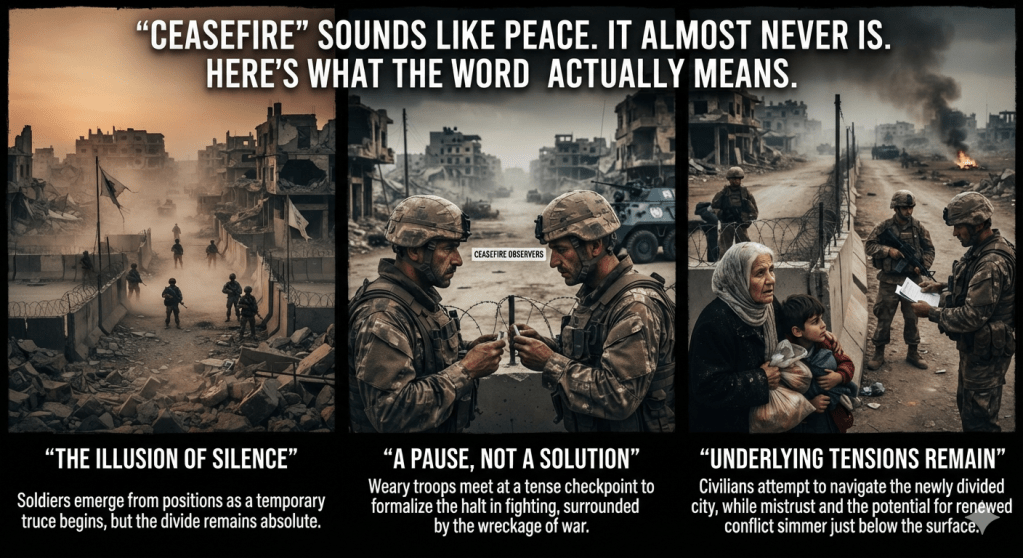
It’s easy to assume a ceasefire is just a smaller, shakier version of peace — a first draft that sometimes doesn’t hold. But that’s not quite right. A ceasefire isn’t really designed to end a war at all. It’s designed to pause one, on terms that almost guarantee the pause is fragile. Understanding why requires understanding what the word actually means — and it means less than most people assume.
Peace Has a Vocabulary, and Most People Only Know One Word
Diplomats and international lawyers actually work with a whole ladder of terms, each one meaning something more permanent than the last. Skipping a rung matters.
At the bottom sits the truce — the loosest, least formal option. Historically, this might be nothing more than two commanders on a battlefield agreeing to stop shooting long enough to collect the wounded. No treaty, no signatures, often no guarantee it survives past nightfall.
One step up is the ceasefire — more official, usually announced or brokered by governments or international bodies, but still fundamentally temporary. A ceasefire stops the shooting. It does not resolve why the shooting started, and it typically comes with an expiration date, explicit or implied.
Higher still is the armistice — a formal, legally binding agreement to permanently halt military operations. This is the word that ended the fighting in both World Wars and in Korea. Crucially, though, even an armistice isn’t a peace treaty. It moves a conflict off the battlefield and into the negotiating room — but the negotiating room can sit empty for decades.
Which brings us to the strangest fact in modern geopolitics: the Korean War never actually ended. The armistice signed in 1953 stopped the shooting, built the DMZ, and set up a prisoner exchange — but the peace treaty that was supposed to follow never got signed. Seventy-plus years later, North and South Korea remain, on paper, still at war, held apart by an agreement everyone always intended to be temporary.
That’s the whole point, and the whole problem: a ceasefire is a pause button, not an off switch.
So Why Do They Keep Breaking?
If you follow international news for even a year, you’ll watch this cycle repeat: announcement, cautious hope, then a violation, then collapse, then — eventually — another announcement. It can feel almost absurd, like watching the same movie on a loop with a different cast. But researchers who actually study ceasefire collapse have identified a few recurring reasons it happens, and none of them are really about bad luck.
1. Nobody’s actually agreed on what happens next
Here’s an uncomfortable truth: most ceasefires aren’t peace agreements at all — they’re temporary suspensions of violence, shaped by mistrust and unresolved political goals. If the underlying reasons two sides went to war in the first place — a border dispute, a fight over territory, a demand for independence — are still sitting there unresolved, the ceasefire hasn’t removed the source of the conflict. It’s just paused the clock on it. When the drivers of the conflict remain intact, the ceasefire tends to collapse.
2. Trust is the scarcest resource in any warzone
Political scientists have a name for one of the most common ceasefire killers: the security dilemma. It sounds abstract, but the logic is brutally simple. Imagine both sides genuinely want the peace to hold — but neither one fully trusts the other not to strike first. So each side quietly keeps preparing, just in case. And each side’s defensive preparation looks, from the other side’s perspective, exactly like aggression. Each side’s efforts to protect itself end up threatening the other side, and their worst fears can become a self-fulfilling prophecy — even when nobody actually wanted the fighting to restart.
3. Not everyone at the table wants the deal to work
Ceasefires rarely involve just two unified sides shaking hands. Real conflicts are messy coalitions — governments, militias, factions, hardliners, and moderates who don’t always agree with each other, let alone with the enemy. Researchers call the disruptive faction a spoiler: a group inside (or loosely aligned with) one side that actively benefits from the war continuing, and has every incentive to blow the ceasefire up. Even when top leaders genuinely want a truce to last, more extreme factions on either side can unravel it — sometimes all it takes is one provocative move.
4. Nobody’s watching, so nobody can prove who broke it first
One of the clearest, most consistent findings in the academic research on this is almost boringly practical: ceasefires with real monitoring last longer. Agreements that include actual monitoring provisions are associated with a significantly longer absence of violence than agreements based purely on trust. Without neutral observers on the ground, every incident becomes a game of dueling accusations — each side blaming the other, no independent way to verify who actually fired first, and no consequence for whoever did.
5. The clock is the most dangerous part
Ceasefire researchers have also found something almost eerie: the risk of collapse is highest right at the very start of a truce, and again right at the end of its first phase, if talks about what comes next start breaking down. The beginning is risky because trust hasn’t built yet. The deadline is risky because it forces a decision — extend, escalate, or renegotiate — precisely when tensions are already high.
The Uncomfortable Truth: A Broken Ceasefire Isn’t Necessarily a Failed One
Here’s the part that trips people up: judged purely by “did it hold,” a ceasefire that collapses after six weeks looks like a failure. But those six weeks were real. Real convoys of aid got through. Real hostages or prisoners came home. Real families got a window without airstrikes. A ceasefire’s actual job was never “end the war forever” — it was “stop this specific bleeding right now, and buy time.” By that narrower standard, even a ceasefire that eventually breaks can still have done real, measurable good.
The catch is what happens with the time it buys. A ceasefire is only ever a bridge — and a bridge is only useful if somebody actually builds something durable on the other side of it. When ceasefires replace a real political solution instead of creating a pathway toward one, they don’t resolve anything — they just reset the clock on the same pattern of truce, breach, and renewed conflict.
That’s really the whole story, told across a hundred conflicts and eighty years of diplomacy: a ceasefire was never the destination. It was always just the pause — and whether that pause becomes peace depends entirely on what the two sides do with it before the clock runs out again.
Got a subject you want covered in Curious Context? Send it over — geopolitics, history, case studies, and more.


Leave a comment