Curious Context | History
Here’s a strange fact: the reason a nuclear war hasn’t happened yet isn’t really about missiles, or generals, or treaties. It’s about an idea. A weird, counterintuitive, almost paradoxical idea, dreamed up by a small group of economists and mathematicians who had never fired a gun in anger — and who solved the most dangerous problem in human history using something closer to poker strategy than military science.
That idea is called deterrence. And its origin story is one of the strangest in modern history.
The Weapon That Broke the Rules
For all of human history, the logic of weapons was simple: build the biggest one, win the war. Bronze swords beat wooden clubs. Cannons beat swords. Tanks beat cavalry. Bigger stick, better outcome. That was the whole game, for thousands of years.
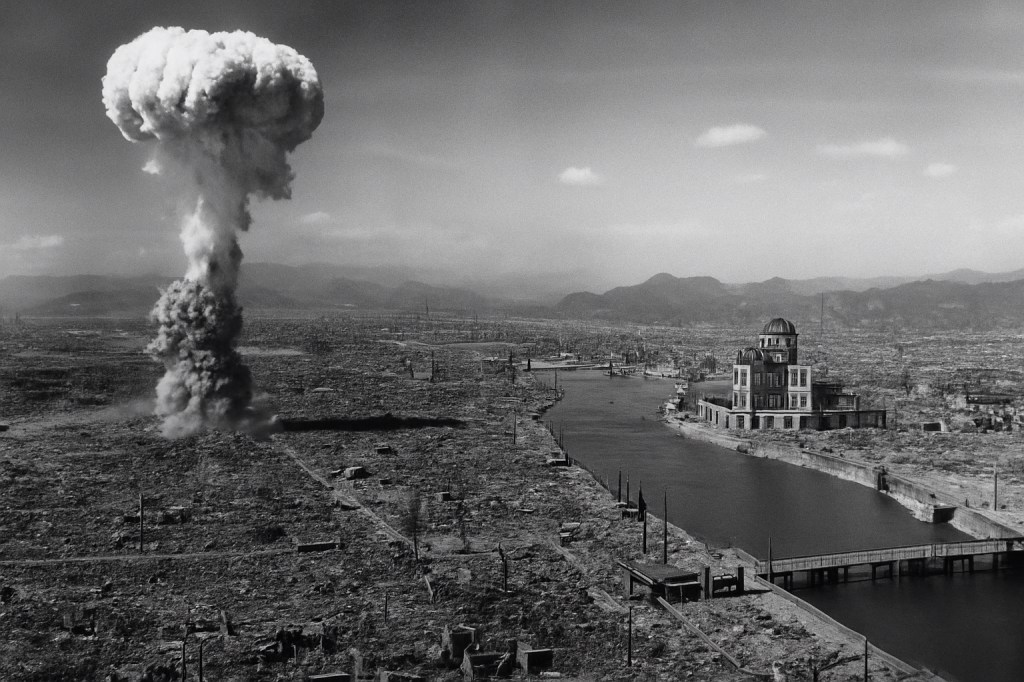
Then, in August 1945, two American bombs erased two Japanese cities in an afternoon — and broke the game entirely.
Because here was a weapon so powerful that using it didn’t win anything. It just ended things. If both sides eventually had one, “winning” a war between them stopped being possible in any normal sense. So what was the weapon for?
Nobody actually knew. There was no manual for this. And into that void stepped a handful of thinkers who would spend the next fifteen years inventing one — from scratch, on the fly, with the fate of the planet quietly riding on whether they got it right.
Meet the Man Who Flipped the Entire Idea of War
The person usually credited as patient zero of this whole intellectual revolution is Bernard Brodie — not a general, but a mild-mannered naval strategist teaching at Yale. Barely a year after Hiroshima, Brodie gathered a group of scholars and wrote a book called The Absolute Weapon. Inside it was a single paragraph that quietly rewrote the purpose of every army on Earth.
Brodie’s argument, boiled down: militaries have always existed to win wars. From now on, their job is to make sure wars never start at all. That’s it. That’s practically the entire job description of every army from this point forward.
Sit with that for a second, because it’s genuinely bizarre. Imagine building the most powerful machine ever created and concluding that its entire value comes from never turning it on. That’s not how any weapon in history had ever worked before. And once you accept it, everything about how you think, plan, and negotiate has to change.
The Weirdest Think Tank on Earth
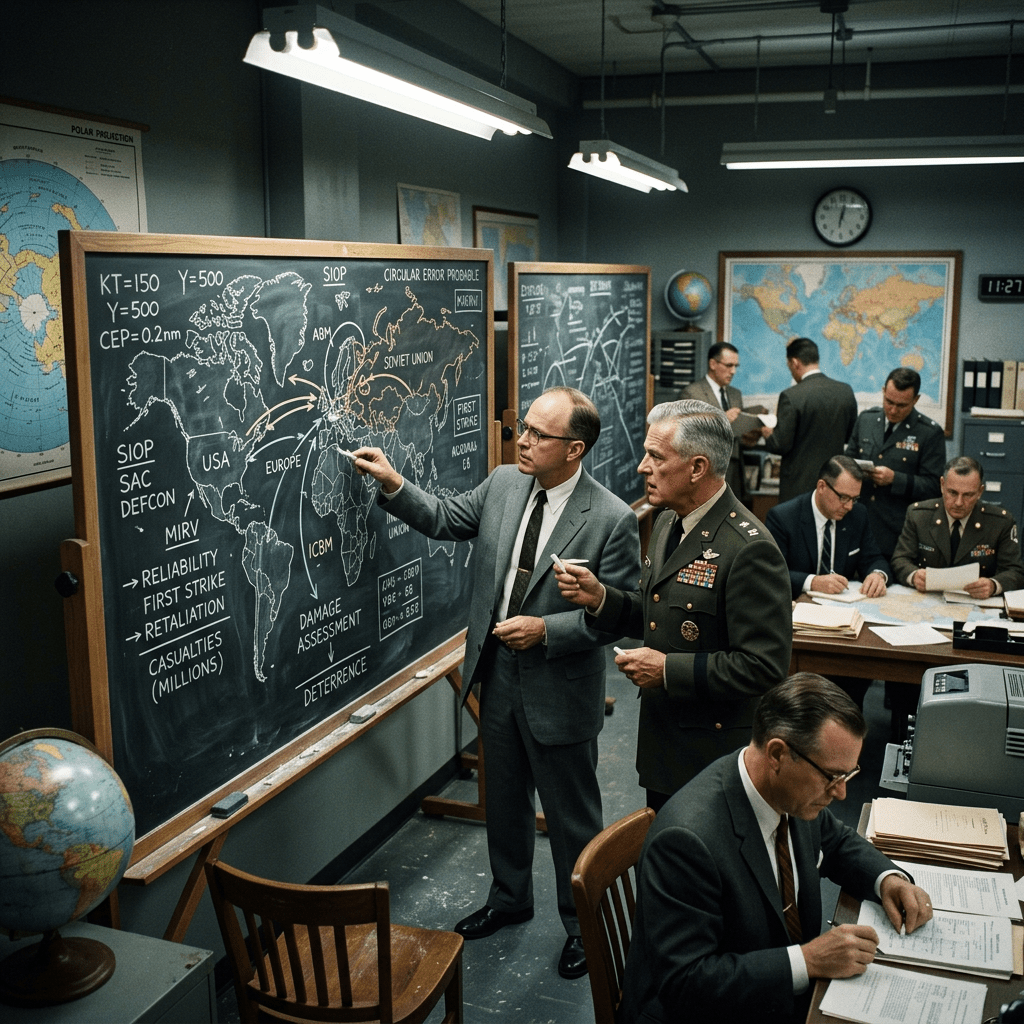
Brodie’s idea might have stayed a clever line in an academic book if it hadn’t landed at RAND — a strange, secretive, Air Force–funded think tank based in Santa Monica, California, of all places. Picture sun, palm trees, and a building full of the most paranoid, brilliant minds in America, quietly calculating how many American cities could survive a Soviet first strike.
RAND became a magnet for people who thought about war the way you’d think about a chess problem or a math proof: Brodie, an economist named Thomas Schelling, a physicist-turned-strategist named Albert Wohlstetter, and a man named Herman Kahn who would go on to become so unnervingly comfortable discussing mass death that he partly inspired the title character of Dr. Strangelove.
Within about a decade, this small, odd group had built an entirely new field of thought from nothing: nuclear strategy. Not because a president ordered them to — mostly because nobody else was doing it, and somebody had to.
The Economist Who Solved Armageddon Like a Poker Hand
If Brodie supplied the why, Thomas Schelling supplied the how — and his answer came from the strangest possible place: game theory, a fairly obscure branch of math mostly used at the time to study poker and price wars.
Schelling’s insight was that a threat is only as good as the other player’s belief in it. It didn’t matter how many bombs you had if your opponent didn’t believe you’d actually use them — and it didn’t matter if you had far fewer, as long as they were certain you would. Nuclear standoff, in other words, wasn’t really a military problem. It was a psychology problem, dressed up in missiles.
He gave the world sharp, sticky phrases that are still used today — describing slow, deniable aggression (think: island-building in disputed waters, or troops massing “for exercises”) as “salami slicing”: taking a conflict one thin, unprovocative slice at a time until, suddenly, the whole thing is gone. He also described something darker: “the threat that leaves something to chance” — the unsettling idea that a leader could make a threat more credible not by promising to act, but by letting a crisis edge toward chaos on its own, so that even they might not fully control what happened next. Terrifying? Yes. Also, weirdly, exactly what kept both sides cautious for forty years.
The Man Who Stared Straight at the Apocalypse
Not everyone at RAND shared Schelling’s careful tone. Herman Kahn did something almost nobody else was willing to do: he sat down and actually war-gamed nuclear conflict, step by step, in exhaustive and clinical detail. His 1960 book On Thermonuclear War laid out something he called the “escalation ladder” — 44 distinct rungs running from minor political posturing all the way up to full civilizational collapse.
People were horrified. Kahn talked about tens of millions of deaths the way most people talk about a bad commute. But his uncomfortable logic mattered for one simple reason: if your entire strategy depends on a threat being believed, somebody has to be willing to actually think through what happens if it isn’t.
Where “MAD” Actually Came From
By the early 1960s, all these pieces clicked into a single, elegant, horrifying shape: if both superpowers could survive a first strike and still guarantee a devastating counterattack, then striking first made no sense for anyone. Nobody could win. Everybody could only lose, together.
Kahn is usually credited with coining the phrase “mutual assured destruction” in 1962. But it was his colleague Donald Brennan who compressed it into an acronym — and did it deliberately, spelling out the word MAD as a pointed joke, arguing that a strategy built entirely on the threat of annihilating civilization was, quite literally, insane.
The joke worked too well. The label outlived the punchline and became the standard term for the entire doctrine — used just as often today by defense officials as it was by the man who coined it as a warning.
Even the theory’s own architects didn’t agree on whether it was good news. Kenneth Waltz thought MAD was a stabilizing force — the thing quietly keeping the peace. Kahn spent much of his career doing the opposite: probing for scenarios where a nuclear war might actually be fought, survived, and “won,” directly undermining the very idea he’d helped name.
A Theory Nobody Wanted to Test
Here’s the part that should really unsettle you: none of this was based on evidence. There was no dataset of past nuclear wars to check the theory against, no historical pattern to lean on. It was built entirely on logic, math, and psychology — a bet on human rationality made with the highest possible stakes, before anyone knew if it would hold.
It came closest to a real test in October 1962, during the Cuban Missile Crisis. For thirteen days, everything these RAND theorists had spent a decade sketching on paper got tested against real submarines, real missiles ninety miles from Florida, and real leaders working with incomplete, often wrong information about each other’s intentions.
It held. But historians still argue, honestly, about how much of that was sound theory — and how much was simply luck.
An Idea Still Running the World
That tension never really went away. Every modern nuclear standoff — Russia and NATO, India and Pakistan, the unresolved question of North Korea — still runs, at some level, on assumptions first scratched out on chalkboards in Santa Monica by a handful of economists and mathematicians who were just trying to reason their way through a weapon nobody had ever had to live with before.
Eighty-one years after Hiroshima, we’re all still living inside their answer.
Got a subject you want covered in Curious Context? Send it over — geopolitics, history, case studies, and more.


Leave a comment