
Every few months, a headline declares that the US dollar’s reign is ending. BRICS nations are “abandoning” it. Gold is the “new dollar.” A mysterious “BRICS currency” is coming to replace it. It sounds like the opening of a thriller — the world’s most powerful currency, quietly dethroned while nobody’s watching.
So here’s the curious part: almost none of that is quite true. And the real story, buried under the hype, is actually more interesting than the headlines.
The Number Everyone Quotes (And Why It’s Misleading)
Start with the statistic you’ve probably seen: the dollar’s share of global foreign exchange reserves has slid from a peak of 72% in 2001 to under 57% today — falling below 57% for the first time since 1995, according to IMF data.
That’s real. It’s also been happening for two decades, long before “de-dollarization” became a buzzword. A quarter-century decline isn’t a collapse — it’s erosion. And erosion, geologists will tell you, is slow, uneven, and doesn’t necessarily mean the mountain disappears.
Here’s the number the headlines leave out: despite all the talk, nearly 90% of global transactions are still conducted in dollars, with the currency representing close to 60% of central bank reserves — while the euro sits around 20% and the yuan trails at under 3%. That last figure is the one that should surprise you. China is the world’s second-largest economy, a BRICS founding member, and the loudest voice pushing alternatives to the dollar — and its own currency barely registers as a global reserve asset.
So What’s Actually Changing?
If the dollar isn’t collapsing, something is still shifting. Three things, in particular.
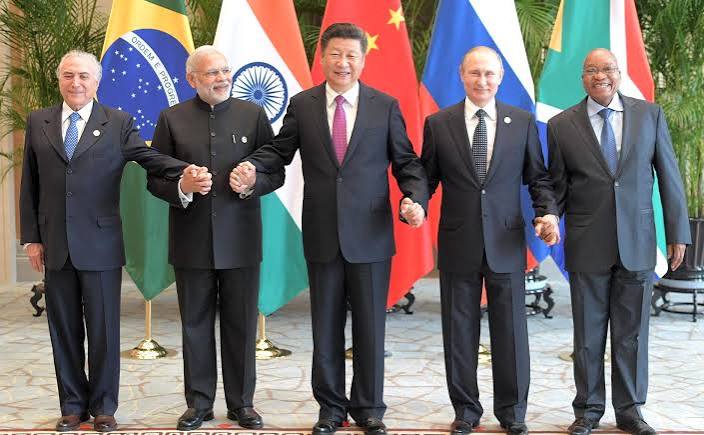
1. Trade settlement is quietly going local. This is where the real movement is happening — not in reserves, but in how countries pay each other for goods. BRICS nations now settle roughly 67% of trade within the bloc in local currencies, up from under 20% a decade ago. Russia and China have gone furthest: the two now settle around 90% of their bilateral trade in rubles and yuan. That’s less about ideology and more about necessity — after Western sanctions froze Russia out of dollar-based systems, rubles and yuan became the only practical option.
2. Central banks are quietly hoarding gold. While everyone argues about currencies, central banks have been making a different bet entirely. Gold’s share of global reserves has climbed from 13% in 2017 to roughly 30% in 2025, with BRICS+ nations alone now holding 17.4% of global gold reserves — up from 11.2% in 2019. Gold doesn’t answer to any government, can’t be frozen by sanctions, and doesn’t care who’s president of the United States. For countries worried about being locked out of the dollar system the way Russia was, that neutrality is the whole point.
3. The plumbing is being rebuilt. Alternatives to SWIFT — the messaging network that underpins most international payments — used to be theoretical. Not anymore. Systems like China’s CIPS, the multi-country mBridge platform, and more than 40 bilateral yuan swap lines now provide settlement infrastructure that simply didn’t exist five years ago. Infrastructure is the boring part of geopolitics, but it’s often the part that matters most: you can’t de-dollarize with speeches, you need pipes to move money through.
The BRICS Currency That (Probably) Isn’t Coming
You’ve likely heard whispers of a new “BRICS currency” — sometimes called the “Unit” — designed to rival the dollar directly. It makes for a great headline. It is not, however, close to reality. Analysts widely note that the proposed BRICS unit remains years away from being operational for anything beyond settling trade within the bloc itself.
And not everyone in BRICS even wants a rival currency. India, a founding member, has been notably cool on the idea. Its own foreign minister put it bluntly, saying India has no policy to replace the dollar and considers it a source of global economic stability. When one of your bloc’s five founding members won’t sign onto your headline project, that project isn’t happening anytime soon.
Why This Is Happening At All
If the dollar is still this dominant, why are so many countries hedging against it? The honest answer is Washington gave them a reason to. The freezing of roughly $300 billion in Russian central bank reserves in 2022, along with restrictions on Iran’s access to SWIFT, showed dozens of nations that dollar exposure comes with political risk attached. If your money can be frozen because of a decision made in Washington, holding all your eggs in that basket starts to look less like prudence and more like vulnerability.
That’s the real engine behind de-dollarization — not ideology, not a grand plan to dethrone America, but risk management. Countries are quietly building a spare tire, not scrapping the car.
The More Likely Future
Most serious analysts don’t expect a “post-dollar world” — they expect something messier and more interesting: a system where the dollar remains the default, but is no longer the only serious option. Call it dollar-centered competition rather than dollar collapse. The shift will show up gradually — in a swap line here, a gold purchase there, a new payment corridor somewhere else — rather than in one dramatic announcement.
The euro, for what it’s worth, may be a bigger quiet winner than any BRICS alternative. Unlike a hypothetical new currency, it already has a central bank, a deep bond market, and decades of institutional trust behind it, and its role in global finance has been edging upward.
The Takeaway
So — real trend or overhyped story? Both, in different proportions. The trend is real: sanctions risk, trade settlement patterns, and gold buying all point toward a world with more currency options than it had twenty years ago. But the “dollar collapse” narrative is mostly noise. The dollar isn’t being overthrown. It’s being joined — reluctantly, by countries hedging their bets in a more unpredictable world.
The empire isn’t falling. It’s just no longer the only game in town.
Curious Context is about looking past the headline and finding the story underneath it. Got a topic you want unpacked next? Send it our way.


Leave a comment