How a single company convinced the world that a common stone was precious, and that love had a price tag
Pick up any diamond ring and someone will probably tell you the same thing: diamonds are rare, which is why they’re expensive, which is why they’re a fitting symbol of a love that’s supposed to last forever.
Almost none of that sentence is true.
Diamonds are not especially rare. Geologically, they are one of the more abundant gemstones on Earth. The idea that they’re precious because they’re scarce, and the idea that they belong on an engagement ring at all, were not handed down by nature or tradition. They were built, on purpose, over about seventy years, by one company. This is the story of how De Beers didn’t just corner a market. It invented the reason you’d want to buy from it in the first place.
The stone that wasn’t supposed to be worth much
In 1870, huge diamond deposits were discovered near the Orange River in South Africa. This should have been bad news for diamond prices. Suddenly, instead of a handful of scattered finds from India and Brazil, there were tons of the things coming out of the ground.
Cecil Rhodes, the businessman who would go on to found De Beers Consolidated Mines, understood something that most people in the diamond business missed: a gemstone’s value has almost nothing to do with how hard it is to find. It has to do with how hard it is to get. If you control the supply, you control the price, no matter how much of the stuff is sitting underground.
So Rhodes and his successors set out to buy up every diamond mine they could. By the early 20th century, De Beers controlled roughly 90% of the world’s rough diamond supply. Not because diamonds were rare, but because De Beers made sure the market behaved as if they were.
How you keep a “rare” stone rare when it isn’t
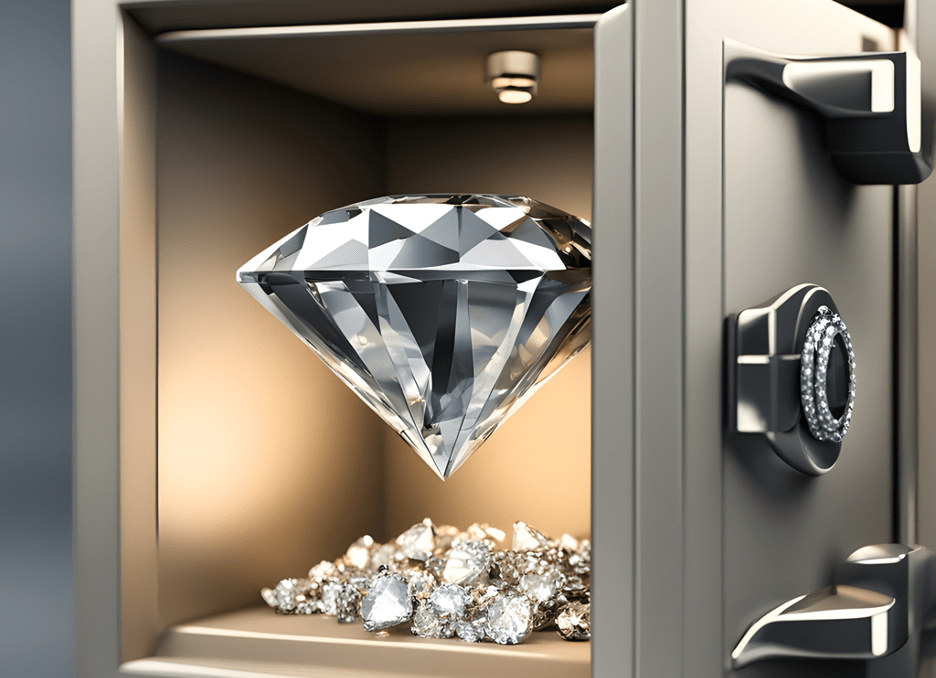
Running a cartel is harder than it sounds, especially when new diamond deposits keep turning up in inconvenient places. De Beers’ solution was simple in concept and relentless in execution: buy the diamonds other people found, and lock them in a vault.
For decades, De Beers held a stockpile of rough diamonds worth billions of dollars. When a new mine came online, whether in Congo, Namibia, or the Soviet Union, De Beers would either buy up the country’s production directly or strike a deal to control how much reached the open market. When the Soviets started selling diamonds independently in the 1950s, threatening to flood the market, De Beers simply arranged to buy their output too.
The message to any would-be competitor was blunt. In one case, when a smaller producer tried selling outside the cartel, De Beers responded by dumping diamonds onto the market and crashing the price. It recovered within months, once the message had landed: sell through us, or watch your diamonds become worthless.
It was, in effect, a company that had learned how to manufacture scarcity as a product in itself.
The bigger problem: nobody wanted one
Controlling supply solved half the problem. But by the late 1930s, De Beers had a second, more embarrassing issue: not enough people actually wanted to buy diamonds.
In the United States, diamond engagement rings were far from universal. Many couples chose other stones, or no stone at all. In Europe, the tradition barely existed. Rhodes’ successor, Harry Oppenheimer, understood that a warehouse full of “rare” stones is worthless if nobody sees the point of buying one.
In 1938, Oppenheimer met with the president of the N. W. Ayer advertising agency in New York. What followed was not a normal ad campaign. It was closer to a decades-long project to rewire what an entire culture believed a wedding proposal required.
Ayer didn’t just run ads. It planted stories in newspapers and magazines about diamonds and romance, dressed up as regular editorial content. It courted Hollywood, arranging for stars to wear diamonds on screen and off. It targeted men directly, framing a diamond purchase as proof of a man’s success and seriousness. Slowly, a diamond stopped being a purchase and became a rite of passage.
Four words that changed how the world proposes marriage
In 1947, a copywriter at Ayer named Frances Gerety scribbled a line at the end of a late-night ad session: “A Diamond Is Forever.”
It became, by Advertising Age‘s own reckoning, the most effective advertising slogan of the twentieth century. But its real genius wasn’t as a slogan. It was as a piece of financial engineering disguised as poetry.
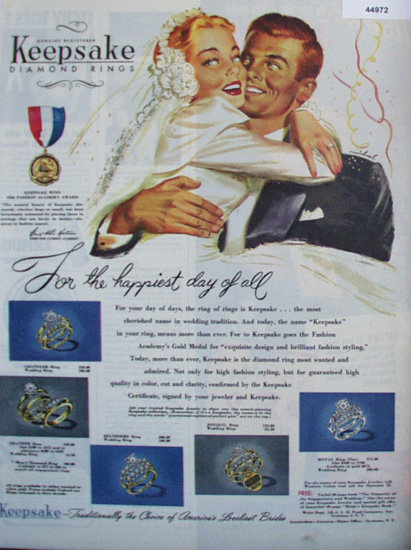
Think about what those four words actually accomplish. They don’t just say a diamond is beautiful or expensive. They say a diamond should never be resold. Selling your “forever” diamond would look like admitting your marriage had failed. So instead of feeding into a resale market that might reveal what diamonds are really worth, almost every diamond ever sold for an engagement simply vanished into a drawer, permanently, by design. De Beers hadn’t just created demand. It had made sure that demand could never generate a competing supply of secondhand stones to undercut its prices.
The campaign ran, essentially unchanged in spirit, for over seventy years.
A stone with no fixed price, only an engineered one
Here’s the part that tends to surprise people most: diamonds have no consistent, transparent open market the way gold or oil does. There’s no diamond stock exchange with a public price ticker. For most of the twentieth century, one company decided how many diamonds the world would see and roughly what they’d cost, and then spent decades convincing people that price was a reflection of the stone’s rarity rather than the cartel’s decisions.
Rubies are, by most measures, rarer than diamonds. So are several other gemstones. But none of them got the seventy-year advertising campaign, the Hollywood placements, or the four-word slogan that turned a purchase into an obligation.
What eventually cracked the cartel
De Beers’ grip loosened, but not because people stopped wanting diamonds. New mines in Canada, Russia, and Australia found producers willing to sell outside De Beers’ control. Concerns over “blood diamonds,” stones mined in conflict zones to fund violence, damaged the industry’s image and forced De Beers to publicly change how it sourced its stones. By the 2010s, De Beers’ share of the global rough diamond market, once above 90%, had fallen to roughly half.
The company still exists. The slogan, remarkably, still runs. But the near-total monopoly that made the whole system possible is gone.
The real lesson
The De Beers story isn’t really about diamonds. It’s about how easily “value” can be manufactured when a company controls both what reaches the market and what the market is told to feel about it. De Beers didn’t just sell a product. It sold a belief so complete that, generations later, most people have never thought to question it.
The next time someone tells you a diamond is valuable because it’s rare, you’ll know the truth: it’s valuable because, a very long time ago, a handful of people decided it should be, and then spent a fortune making sure you’d agree with them.


Leave a comment